Here is something people without POTS rarely understand.
The appointment is not the hard part. Getting dressed is. Standing in a shower is. The drive, the waiting room chair, the walk back to the car, and then the two days afterwards spent paying for all of it. By the time you have seen someone for forty minutes, the visit has cost you most of a week.
Which is why managing POTS at home is not a lesser version of proper care. For this condition specifically, it is the main event — the part that happens on the days you are not spending everything you have to get somewhere.
Start Where the Evidence Starts
Before anything else, the foundations that mainstream POTS management already recommends. If these are not in place, nothing layered on top will perform well.
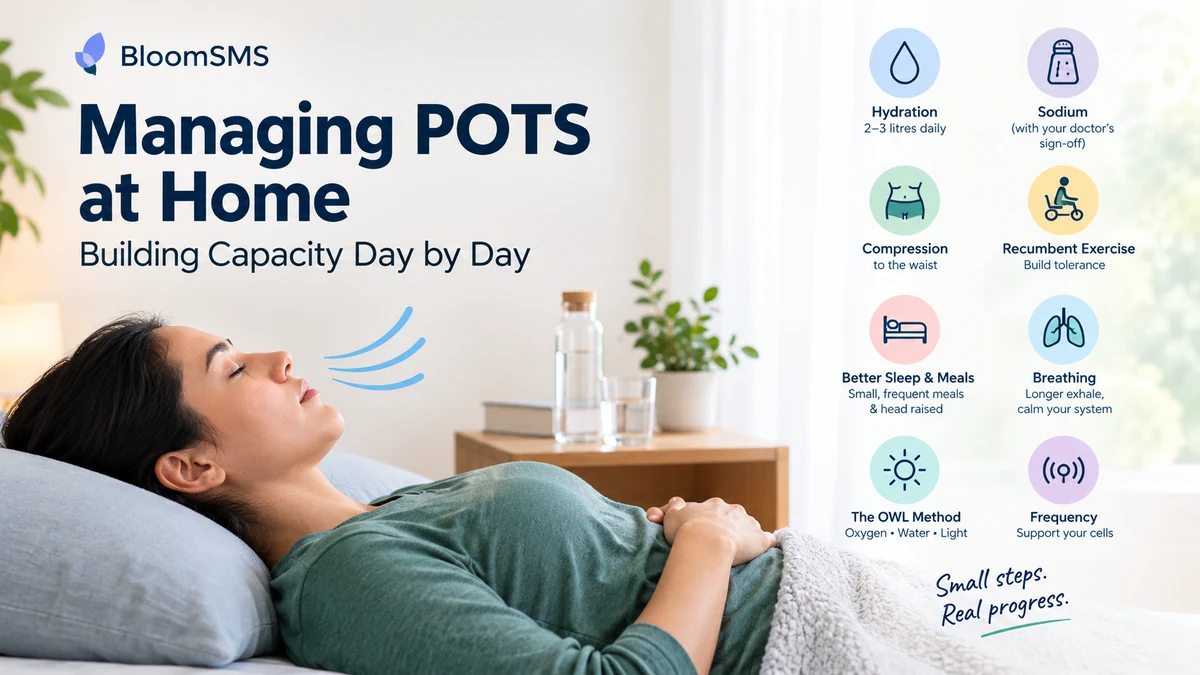
- Fluid — roughly 2 to 3 litres daily for most adults, spread through the day rather than in large amounts at once
- Sodium, with your doctor’s sign-off — it helps you hold on to the fluid you are drinking, and the right amount depends on your kidneys, blood pressure and whether you are pregnant. Get your number from your physician, not from an article
- Compression to the waist — or an abdominal binder. Knee-high socks miss most of the pooling, which happens in the abdomen and pelvis
- Exercise starting horizontally — rowing, swimming or a recumbent bike, so you build conditioning without provoking the upright response. Upright work comes later, as tolerance allows
- Bed raised at the head, smaller and more frequent meals, and standing up in stages rather than all at once
If you have previously concluded that exercise makes your POTS worse, it is worth knowing that this is almost always a starting-position problem rather than an exercise problem. Beginning upright provokes the exact response you are trying to build tolerance against.
Breathing Is the One Lever That Reaches the Autonomic System Directly
Most of what your autonomic nervous system does is outside voluntary control. You cannot decide to constrict a blood vessel or slow your digestion.
Breathing is the exception, and that makes it disproportionately valuable in dysautonomia. Extending your exhale so it runs longer than your inhale engages the parasympathetic side directly — the branch that handles rest, digestion and repair, and the one a POTS system spends too little time on.
Start lying down, which removes the orthostatic load entirely. Five minutes, several times a day, with an exhale roughly twice the length of the inhale. It costs nothing, it works within minutes, and it is available on your worst days when nothing else is.
The OWL Foundations, With POTS in Mind
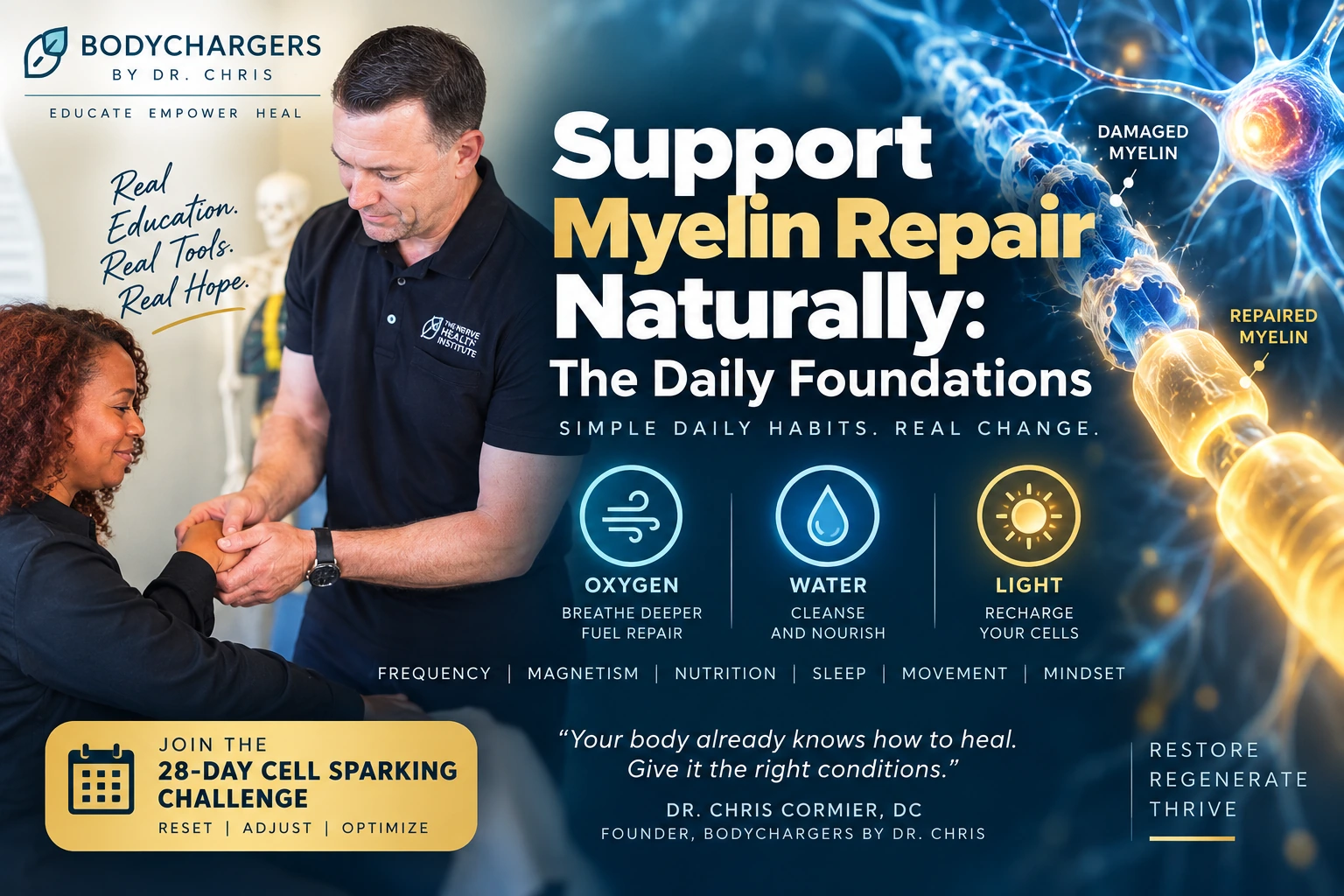
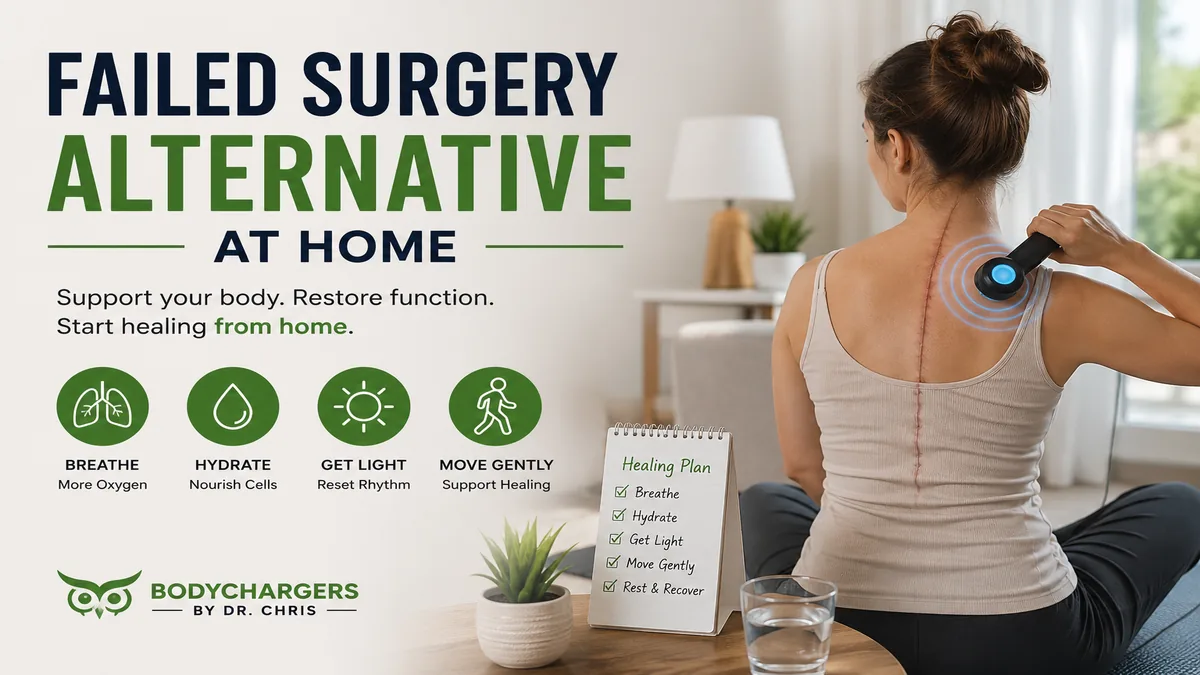
Oxygen, Water and Light — the OWL Method — sit underneath everything your cells do. With a system already running at the edge of its capacity, they matter more than usual.
Oxygen. Beyond the breathing work above, notice how shallowly you breathe during symptoms. Most people brace and hold when they feel lightheaded, which is precisely backwards.
Water. Steady through the day rather than in bursts. Set a rhythm you can maintain on a bad day, not one that only works on a good one.
Light. Morning daylight anchors the rhythm that governs sleep depth, and sleep is where tomorrow’s capacity is set. If getting outside is too costly, sitting by a window works. Dim the evening — screens late at night undo the morning’s work.
Frequency: Support That Does Not Require Leaving the House
Every tissue carries its own resonant frequency, much like a guitar string with its own correct pitch. Under sustained stress, tissue drifts out of tune and performs below what it could.
Frequency work aims at bringing it back, and portability is what makes it relevant here. The DeVita line available through BodyChargers — RITM, AP, deAqua, QiOne and Energy 11 — runs programmes for nervous system regulation, digestion and more from something you can use lying on the sofa.
For a condition where the cost of travel is the barrier, support you can run at three in the afternoon on a bad day is a different proposition entirely from support that requires a car journey.
Reset, Adjust, Optimize
The BodyChargers programme runs in three levels, and with POTS the order is not optional.
Reset. Foundations only. Fluid rhythm, breathing, sleep timing, morning light, and honest pacing. Nothing ambitious. Most people find this stage alone changes their week.
Adjust. Targeted support once there is capacity to build on — frequency protocols, graded horizontal conditioning, and working out which triggers are actually yours.
Optimize. Extending tolerance so that standing, heat and ordinary days stop being events you plan around.
The temptation with POTS is to start at Adjust because Reset sounds too basic to matter. It is the most common mistake, and it is why so many people conclude nothing works for them.
The 28-Day Cell Sparking Challenge
Inside the community, the 28-Day Cell Sparking Challenge takes the foundations and turns them into one small daily action rather than a plan you have to organise yourself.
That structure matters more than it sounds. Organising your own health programme takes executive function and energy, and brain fog and fatigue take both. Being told what today’s one thing is removes a barrier that is genuinely part of the condition rather than a motivation problem.
A Day That Works With POTS Instead of Against It
The shape matters as much as the content.
- On waking — drink before standing, then get up in stages: sit, pause, stand. Daylight early if you can manage it
- Morning — put the most demanding task here if mornings are your better window, and before the day heats up
- Through the day — fluid at a steady rhythm, smaller meals, compression on, and counter-pressure before standing: cross the legs, clench the calves
- Afternoon — five minutes of lying-down breathing, taken before you need it rather than after
- Evening — dim light, screens down, consistent bedtime, head of the bed raised
- Daily — one line: standing tolerance, sleep, heat exposure, what you did and what it cost you the next day
That last line is worth more than it looks. Within a couple of months it gives you your own threshold — the amount of activity you can sustain without a payback day — which is the single most useful number a person with POTS can have.
What This Does Not Replace
Get properly diagnosed first. Orthostatic tachycardia can also come from thyroid problems, anaemia, arrhythmias and medication effects, all of which need different treatment. If nobody has formally assessed you, that comes before any of this.
Fainting always needs a physician. If you are losing consciousness, that is an assessment, not a routine. Do not let anyone treat it as just part of having POTS.
Some people need medication, and that is fine. Several are used effectively for POTS. Whether you need one belongs with your doctor, and home work sits alongside it rather than instead of it.
When the Clinic Is Worth the Trip
Home work carries most of the load. Where it stops, the missing piece is usually a hands-on assessment of nerve function — mapping where signal is running below capacity across the body, including areas that have nothing obviously to do with standing up.
That is what the Nerve Health Institute in Lafayette provides, along with clinic technologies that are not practical at home. People generally get far more from that visit having spent a few weeks on the foundations first — which is also how you make the journey worth what it costs you.
The Short Version
POTS takes most of its ground in the ordinary hours, so that is where you take it back. Fluid, sodium where your doctor agrees, compression, horizontal conditioning, breathing, sleep and honest pacing — run consistently, in the right order, on the days nobody is watching.
None of it is dramatic. All of it compounds.
Spark your cells to optimal longevity.
This article is educational and is not medical advice. It does not diagnose or treat any condition. Always consult your physician before changing your treatment, increasing dietary sodium, or beginning an exercise programme.
Frequently Asked Questions
Where do I start if I have almost no energy?
Lying-down breathing and fluid rhythm. Both work from a horizontal position, neither requires standing, and both are available on your worst day. Everything else can wait until there is a little more capacity to build on — that is the whole logic of starting at Reset.
I tried exercise and it made me much worse. Why?
Almost always the starting position. Upright exercise provokes exactly the response POTS struggles with. Programmes designed for this condition begin horizontally or semi-recumbent — rowing, swimming, recumbent cycling — and add upright work only once tolerance has been built. It is worth trying again with the order corrected.
How much salt should I be taking?
That figure has to come from your physician. Increased sodium is standard in POTS management, but it is not right for everyone, and kidney function, blood pressure and pregnancy all change the answer. We are not going to publish a number that could be wrong for you.
Do the devices actually help, or are the basics enough?
For a lot of people the basics do most of the work, and we would rather say that than sell you something you do not need yet. Devices add targeted support once the foundations are consistent. Running them while sleep and hydration are still unaddressed is paying for something you could have had for free.
Can I do this if I cannot get to the clinic?
Yes, and that is precisely why it exists. Travel costs energy that people with POTS do not have spare, so the programme is built to run entirely from home. The clinic is there if and when you want to go further.
Will managing POTS at home actually change anything long term?
Consistency is the thing that moves this condition, and consistency happens at home rather than in appointments. Many people improve substantially with steady management, and some — particularly where POTS followed a viral illness — see symptoms resolve over time. We will not promise you an outcome, but the daily work is where the leverage genuinely is.
Start Charging Your Cells Today
Join the BodyChargers community for the OWL Method, the 28-Day Cell Sparking Challenge and device programmes you can run without leaving the house.
Join BodyChargers → bodycharger.com
Call: +1 (337) 456-6555