There is a particular kind of quiet that follows a post-operative appointment where everything is described as fine.
The imaging is clear. The hardware sits exactly where it was placed. The incision has closed. And yet the pain is still with you, or the weakness never fully lifted, or something new has arrived that nobody quite has a name for. You leave with the sense that the story is finished on paper and unfinished in your body.
That is usually the moment people start looking for a failed surgery alternative — something other than another procedure, and something they can begin on their own rather than waiting for the next available appointment.
There is a great deal available in that space, and most of it is about one idea: your cells are the ones doing the healing, and they will do it well when they are properly powered and properly tuned.
A Repaired Structure and a Working One Are Not the Same Thing
Imaging is exceptional at showing structure. It shows where a disc sits, whether a joint is stable, whether a fusion has taken. What it does not show is whether signal is reaching the tissue around that repair.
This is why two people can share an identical scan and live completely different lives. One has the finding and no symptoms at all. The other has significant symptoms with imaging that looks unremarkable. The structure is only half the picture; the other half is EnergyFlow — whether the brain is actually reaching the cells in question.
Think of the brain as a single power company serving trillions of houses. A scan can confirm the cables are intact. It cannot confirm the lights are on. And when a region has been cut through, moved and rebuilt, the question of whether power is fully reaching it again is exactly the question worth asking.
Why the Body Stays in Protection Mode Long After the Incision Closes
Your autonomic nervous system runs on two settings. The sympathetic side handles protection — alertness, guarding, readiness. The parasympathetic side is where digestion, repair and rest live.
Almost all healing happens on the parasympathetic side. An operation, months of unresolved discomfort, and the uncertainty of not knowing how the story ends all pull in the other direction. A body that has been braced for a year is a body running with its repair side turned down.
The encouraging part is that this is a physiological state rather than a personality trait, and states can be shifted. Breathing, light, sleep rhythm and frequency support all move the dial — and every one of them is available to you at home, today, without an appointment.
The OWL Method: Oxygen, Water and Light
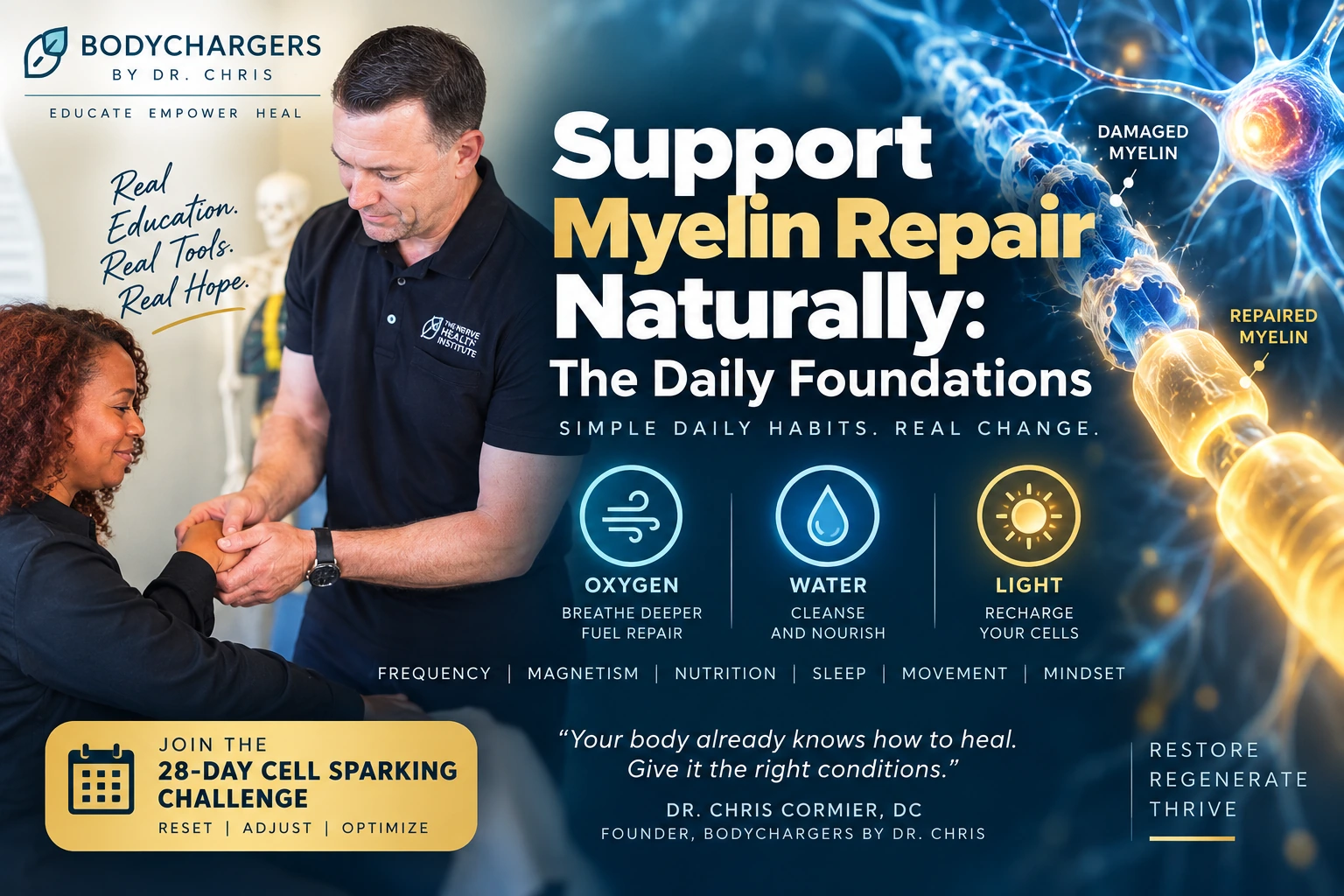
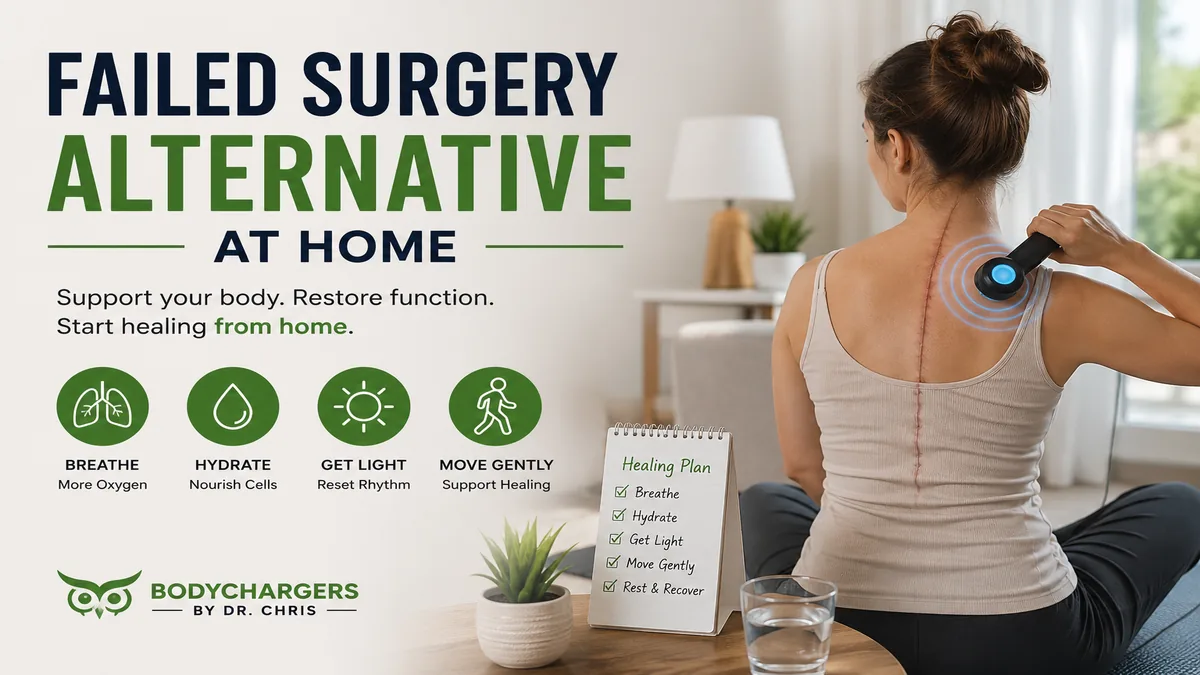
Three inputs sit underneath everything else your cells do. We call them the OWL Method, because they are the foundations you have the most direct influence over.
Oxygen. Recovery is oxygen-hungry work. Slow diaphragmatic breathing with a longer exhale than inhale shifts autonomic state within minutes, and it costs nothing. Five minutes, three times a day, is a genuine intervention rather than a relaxation exercise.
Water. Hydration drives circulation, lymphatic movement and the delivery of everything your tissue needs to rebuild. It is the least glamorous lever available and one of the most reliable.
Light. Bright daylight in the first hour of the morning anchors your circadian rhythm, and circadian rhythm governs the depth of the sleep where most repair happens. Dimming light in the evening protects the same process from the other end.
Sleep consistency and gentle graded movement complete the set. Together these determine how much healing capacity you have to work with — and no technology, in a clinic or at home, outperforms a body with its foundations in place.
Frequency: Bringing Cells Back Into Tune
Einstein suggested that frequency would become the future of medicine, and the reasoning holds up well.
Every tissue has its own resonant frequency. Heart cells, kidney cells, bone cells and muscle cells are each tuned differently, much like the strings on a guitar. A musician hears within seconds when a string has drifted, and adjusts it. Cells drift too — pulled out of tune by physical, emotional and environmental stress — and tissue that is out of tune struggles to do its job.
Bioresonance devices work with that principle, and the technology has become remarkably portable. The DeVita line available through BodyChargers — RITM, AP, deAqua, QiOne and Energy 11 — puts frequency support in your pocket, with programmes you run yourself at home in minutes.
Alongside frequency, the wider self-healing toolkit includes red light and photobiomodulation, PEMF, grounding, and oxygen work such as EWOT with the LiveO2 system. These do not repair a structure. What they support is the cellular environment doing the rebuilding around it.
What a Failed Surgery Alternative Actually Looks Like
When people search for a failed surgery alternative, they are usually being offered one of two things: another operation, or long-term pain management. Both have a place. Neither is the full list.
The at-home options worth understanding group naturally:
- Restoring EnergyFlow — supporting nerve function to the region rather than assuming the imaging settled the question
- Autonomic regulation — moving a guarded nervous system back toward its repair setting
- Frequency and light support — bringing tissue that is healing slowly back into tune
- Oxygen and circulation work — giving rebuilding tissue more to work with
- The OWL foundations — the daily inputs that set your ceiling for everything above
None of these rebuilds a structure, and that limit is worth stating plainly. What they address is everything that decides whether a repaired structure actually performs — which, after a surgery that did not deliver, is very often the part that was never looked at.
Reset, Adjust, Optimize
The BodyChargers programme runs in three levels, and post-surgical recovery maps onto them naturally.
Reset. Foundations first. Breathing, hydration, morning light, sleep rhythm and reducing the load your system is carrying. Most people notice change here before they touch a single device.
Adjust. Targeted support for the areas that are lagging — frequency programmes, light, graded movement matched to your current capacity rather than to where you were before the operation.
Optimize. Holding the gains and building beyond them, so the region that struggled becomes one of the stronger parts of your system rather than the one you protect forever.
This is also why aggressive rehab so often backfires after an unsuccessful procedure. A system running low reads hard loading as threat and guards harder. Matching effort to capacity, then raising capacity, gets further than pushing through.
What to Track While You Rebuild
A short daily note gives you a real record, and gives your medical team something concrete to work from:
- Pain level, and whether it is the original pain or something different
- Function — what you can do this week that you could not last week
- Sleep quality and how you feel in the first ten minutes after waking
- Energy across the whole day rather than at its worst point
- How the surgical area looks and feels as it settles
- Anything that reliably makes things better or worse
One line a day builds a pattern within weeks. Patterns are what turn a vague sense of “some days are better” into something you can act on.
Keep your surgeon in the loop as you go, and contact them promptly about anything sudden — a rapid change in strength or sensation, or changes around the surgical site. Fast answers on those keeps everything else moving forward.
When In-Person Care Makes Sense
Home support does a great deal, and for some people it does everything. For others, a hands-on assessment of all 88 major nerves is the piece that unlocks the rest.
That is what the Nerve Health Institute in Lafayette, Louisiana exists for — a full EnergyFlow evaluation, plus clinic technologies such as hyperbaric oxygen, EBOO Prime and Theralight360 that are not practical to run from a living room. Many people work through the BodyChargers foundations first and visit the clinic already primed to get more from it.
The Part Worth Holding On To
A failed surgery is rarely a badly performed surgery. Much more often it is a correctly performed procedure applied to a picture that was only partly understood.
Your body has never stopped wanting to heal. Cut healthy tissue and it closes so completely you cannot find the line weeks later — that capacity is built in, and it does not switch off because an operation did not go to plan. What it needs is power reaching the cells, tissue in tune, and foundations strong enough to support the work.
That is available to you, and most of it starts at home.
Spark your cells to optimal longevity.
This article is educational and is not medical advice. It does not diagnose or treat any condition. Always consult your surgeon or physician before making changes to your treatment or recovery plan.
Frequently Asked Questions
Is there a failed surgery alternative to having another operation?
Often there is a great deal worth exploring first. Where the issue is genuinely structural — a torn ligament, an unstable joint — that structure needs a surgical answer. But when a repair has already been made and symptoms persist, the useful question becomes whether nerve function, cellular tuning and healing capacity have ever been supported. For many people they have not, and that is where meaningful room to move usually sits.
Why does my body still hurt when the MRI looks normal?
Imaging shows structure, not function. A nerve can look completely clear and still be carrying reduced signal, and symptoms can be generated and sustained by a nervous system stuck in protection mode. A clear scan is genuinely useful information — it rules things out — but it is not the same as an explanation, and it does not mean what you are feeling is imagined.
How soon after surgery can I start this?
The OWL foundations — breathing, hydration, morning light, sleep rhythm — support recovery from the very beginning and many people start them before an operation as preparation. For device work and anything involving the surgical area itself, check the timing with your surgeon first, since that depends on your procedure and how it is healing.
Can this help if my surgery was years ago?
Yes. Time since the operation matters far less than what is currently happening in the tissue and the nervous system. People carrying symptoms for years often see the clearest picture emerge, simply because the pattern has had longer to become visible.
Do the frequency devices replace medical care?
No, and they are not intended to. They support cellular function alongside whatever care you are receiving. Keep your prescribed treatment and your follow-up appointments, and treat home support as an addition to that rather than a substitute for it.
Which BodyChargers level should I start at?
Reset, in almost every case. The foundations decide how much benefit everything else can deliver, and starting with devices while sleep, breathing and hydration are still unaddressed tends to produce smaller results than people hoped for.
Start Charging Your Cells Today
Join the BodyChargers community for the OWL Method, device programmes and step-by-step guidance you can use from home.
[ Join BodyChargers → bodycharger.com ]