
By Dr. Chris Cormier, DC — BodyCharger
Waking at two in the morning to go to the bathroom. A leak when you sneeze, laugh or lift. Planning your route around where the restrooms are. Most people file this under getting older and quietly adjust their life around it.
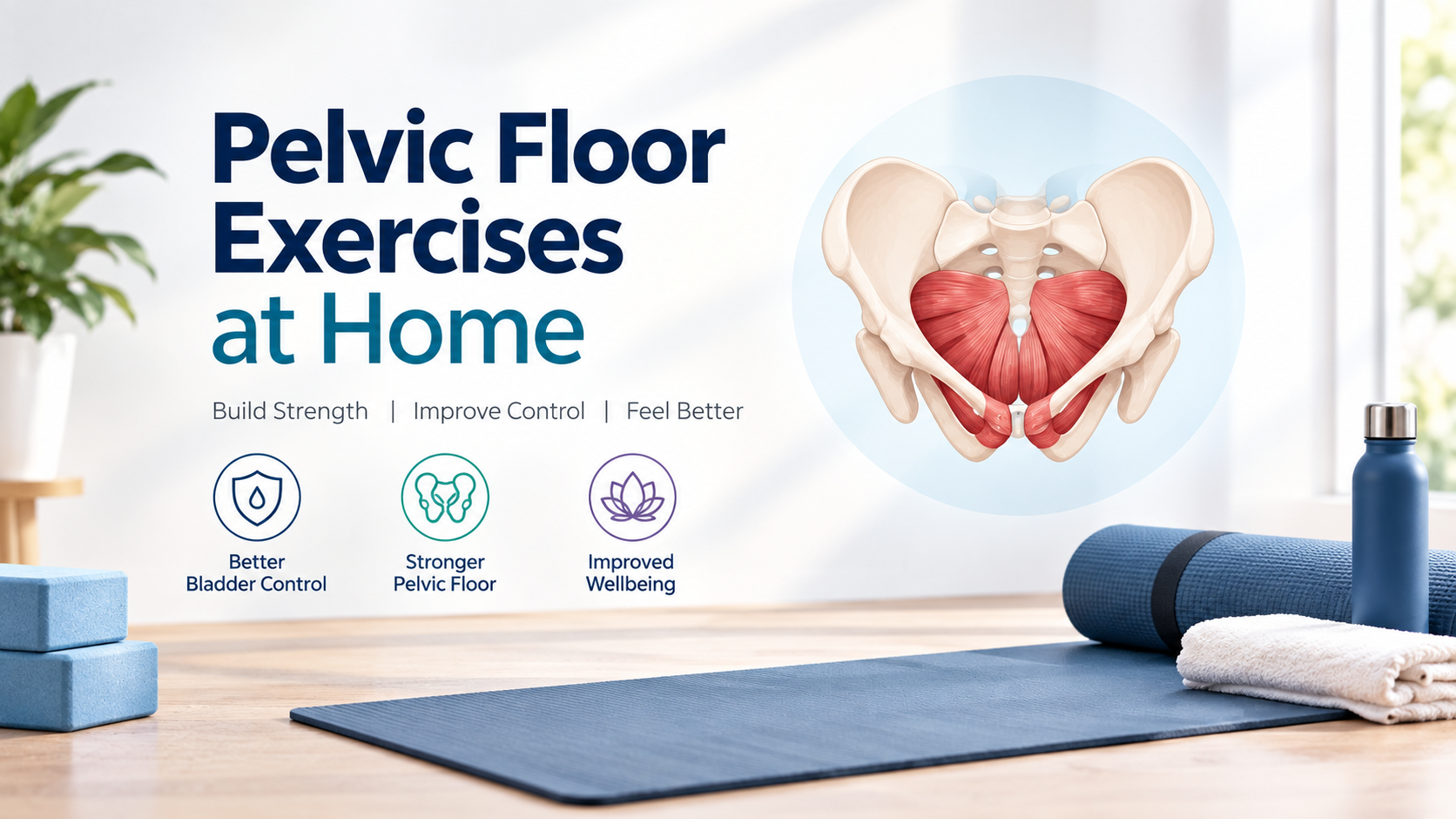
You can start changing it tonight, at home, for free. The pelvic floor is a muscle group — and like every other muscle group, it responds to being trained properly and consistently. Here is the full at-home programme we teach inside BodyCharger, in the order we teach it.
First: make sure you have actually found the muscles
Almost everyone has heard of Kegels. Far fewer are doing them correctly, and that single fact explains most of the disappointing results people report.
The classic cue is the one to start with: imagine you are stopping the flow of urine midstream. That sensation — the lift and squeeze — is your pelvic floor engaging. (Use it as a reference only. Do not make a habit of actually stopping your flow while urinating; that is for finding the muscle, not for training it.)
Here is how to know you have it right:
- You feel a lift — an inward-and-upward sensation, not a push down.
- Your glutes, thighs and abdomen stay relaxed. If your buttocks clench or your belly braces hard, you have recruited the wrong team.
- You can keep breathing. If you are holding your breath to do it, the contraction is coming from the wrong place.
- You can let go completely. The release matters as much as the squeeze. A pelvic floor that cannot relax is not a strong one.
Spend the first week simply finding and confirming the contraction. That foundation makes everything after it work.
Why volume is the real challenge — and how the clinic solves it
Once you can find the muscles, the next question is dose. A committed home routine might produce a few hundred good contractions a week. That builds real strength over months, and it is absolutely worth doing.
It is also worth knowing what the in-clinic option does, because the numbers are striking. At The Nerve Health Institute in Lafayette, the EMSELLA chair uses focused electromagnetic energy to produce 11,200 complete pelvic floor contractions in a single 28-minute session, while you sit fully clothed.
In the published multicentre study of 75 women, 81.33% reported significant symptom improvement after a six-session course, and pad use fell by 53.68% at three-month follow-up. We cover the full detail in our clinic article on the EMSELLA chair.
The two work together rather than competing. The chair delivers volume you cannot produce voluntarily. The home programme is what makes the gains stick — and if you are nowhere near Lafayette, the home programme on its own is still how thousands of people get their nights back.
Your at-home programme, built on the OWL Method
Our framework is oxygen, water and light, supported by frequency, magnetism and nutrients. Here is how each one applies directly to pelvic floor strength.
Oxygen: breathe first, squeeze second
This is the highest-value thing on the page and almost nobody is told it.
Your diaphragm and your pelvic floor move together. When you breathe in properly, the diaphragm descends and the pelvic floor lengthens. When you breathe out, both rise. They are a coordinated pair — which means if your breathing is shallow and high in the chest, your pelvic floor is not getting its natural rhythm.
Practise this daily:
- Lie on your back, knees bent, one hand on your lower ribs and one on your belly.
- Breathe in slowly through your nose for four counts. Feel your lower ribs widen sideways — not your chest rising.
- Breathe out slowly for six counts, and as you exhale, gently lift the pelvic floor.
- Release fully on the next inhale. Ten breaths, twice a day.
Pairing the lift with the exhale is what turns a Kegel into a coordinated movement your body will actually use when you sneeze, lift or laugh. It also shifts you toward the parasympathetic side of your nervous system — the healing, digesting, sleeping side — which is why many people find this single practice improves their sleep as well.
Water: quantity, quality and timing
Three things to get right, all of them free:
- Stay properly hydrated through the day. Cutting fluids to reduce trips backfires — concentrated urine irritates the bladder and can make urgency worse.
- Front-load your intake. Drink most of your water before early evening, and taper in the two to three hours before bed.
- Mind the quality. What is in your water matters as much as how much of it you drink, and we cover filtration and structuring options inside the platform.
If caffeine or alcohol feature in your evenings, experiment with moving them earlier. Both are bladder irritants and both affect sleep depth, which is its own factor in night-time waking.
Light: set the rhythm that governs your nights
Night-time urination affects roughly 40% of adults and becomes more common with age — and sleep quality is part of that picture. The lighter your sleep, the more likely you are to register a bladder signal and get up.
So protect the rhythm. Get daylight into your eyes within an hour of waking — outdoors, no sunglasses, ten minutes is enough to set your body clock for the day. Then dim the lights in the evening and keep screens low and warm for the last hour. A deeper sleep is one of the simplest ways to reduce the number of times you surface at night.
Frequency and magnetism: supporting the cells doing the work
Every cell in your body — including the cells of your bladder, prostate and pelvic floor — carries its own frequency, like a guitar string that wants to stay in tune. Physical, emotional and environmental stress all pull cells out of tune over time.
Inside BodyCharger we include pocket-sized frequency devices and grounding practices you can use daily at home, with dedicated male health and female health sections covering the protocols specific to each.
Nutrients: give the muscle something to build with
Muscle tissue needs protein and the minerals that support contraction — magnesium in particular. Collagen-supporting nutrition matters for the connective tissue that holds the whole pelvic structure together. The nutrient section of the platform covers what we recommend and when.
Reset, Adjust, Optimize: your four-week structure
This is how we sequence everything above so it compounds instead of overwhelming you.
Week 1 — Reset
Find the contraction and confirm it. Start the breathing drill twice daily. Front-load your water and set a consistent wake time. Nothing strenuous — you are rebuilding the connection between brain and muscle.
Weeks 2–3 — Adjust
Add structured sets. Three rounds daily of ten slow contractions — three seconds up, three seconds hold, full release — paired with your exhale. Then add ten quick flicks per round for the fast-twitch fibres that catch a sneeze. Begin your frequency and grounding work.
Week 4 — Optimize
Take the contraction into real life. Lift the pelvic floor before you cough, sneeze, lift something heavy or stand up from a chair. This is called the knack, and it is the point where strength becomes function. Layer in the light, nutrient and recovery practices that suit your routine.
Do it with us: the 28-Day Cell Sparking Challenge
Four weeks is the right length for this work, and doing it alone is the main reason people stop at week two.
The 28-Day Cell Sparking Challenge runs the whole structure above as a guided programme — daily prompts, the breathing and contraction protocols, the water and light practices, and the frequency work, with the male and female tracks built in. You follow along rather than designing it yourself.
It is the core of BodyCharger membership, our at-home platform for self-healing. I cannot be with every patient around the clock, so we built the next best thing: the full method, in your pocket, for the other twenty-three hours.
Adding the clinic chair when you want to accelerate
If you can get to Lafayette, the EMSELLA chair is the fastest way to add volume on top of your home work. A standard course is six sessions over about three weeks, 28 minutes each, fully clothed and completely private.
A few situations call for a different approach, so bring your details to the consultation and we will confirm the right path in a few minutes. These include metal or electronic implants such as joint replacements, surgical plates or screws, pacemakers, defibrillators or a copper IUD; pregnancy or breastfeeding; active cancer or current cancer treatment; seizure or bleeding disorders and blood-thinning medication; and recent pelvic, abdominal or spinal surgery.
Everything in this article remains available to you regardless. Book through The Nerve Health Institute if the chair is a fit, and if systemic circulation and oxygenation are part of your wider picture, we cover EBOO therapy at ebooprime.com.
Frequently asked questions
How long until I notice a difference?
Most people feel better control within three to six weeks of consistent daily practice, with strength continuing to build for several months. The breathing work often produces a noticeable change in the first week or two.
How many Kegels should I do a day?
Three sets of ten slow contractions plus ten quick flicks, once daily, is a solid target once you have confirmed you are using the right muscles. Quality beats quantity — ten well-executed contractions outperform fifty sloppy ones.
Can men do these exercises?
Absolutely. Men have a pelvic floor and almost none of them train it. Everything in this programme applies, and the platform includes a dedicated male health section with specific protocols.
Will this stop me waking up at night?
Pelvic floor strength and bladder control are a major factor for many people, and it is the factor most often left untrained. Fluid timing and sleep depth both play a part too, which is why this programme addresses all three together rather than one in isolation.
Do I need equipment?
No. The breathing, contraction, water and light practices need nothing but your attention. The frequency and grounding tools are optional additions available through the platform.
Start tonight
Find the contraction. Do ten coordinated breaths. Move your last glass of water earlier. That is day one, and it costs you nothing.
When you want the full structure with daily guidance, join BodyCharger and start the 28-Day Cell Sparking Challenge.
Dr. Chris Cormier, DC
Founder, BodyCharger and The Nerve Health Institute
In-clinic care at nervehealth.com. More on how and why we practise this way at drchriscormier.com.
Spark your cells to optimal longevity.