By Dr. Chris Cormier, DC — BodyCharger
Try something before you read any further. It takes four seconds.
Look at your hand. Now look at the furthest thing you can see from where you are sitting. Now back at your hand. Something just adjusted your eyes, twice, and you had nothing to do with it.
That is a nerve doing its job. You have hundreds more of them, and the honest truth is that a good number are doing considerably less than they used to — not because anything is wrong, but because nobody has asked them to do much lately.
Not decline. Disuse.
This is the reframe I want to offer, and it is a far more hopeful way of looking at things than the usual one.
Most of us narrow our movement over the years without noticing. Same chair, same desk, same route, same shoes, same handful of movements. Flat ground, dominant hand, middle of the range, everything at arm’s length.
What follows is not that anything breaks. It is that pathways which do not get used become pathways you have not used — and over a long enough stretch, the difference between those two things becomes hard to tell from the inside.
People call it getting older. A good share of it is simply getting narrower.
And narrowing is reversible, which is the whole reason this article exists.
Why this matters more than it sounds
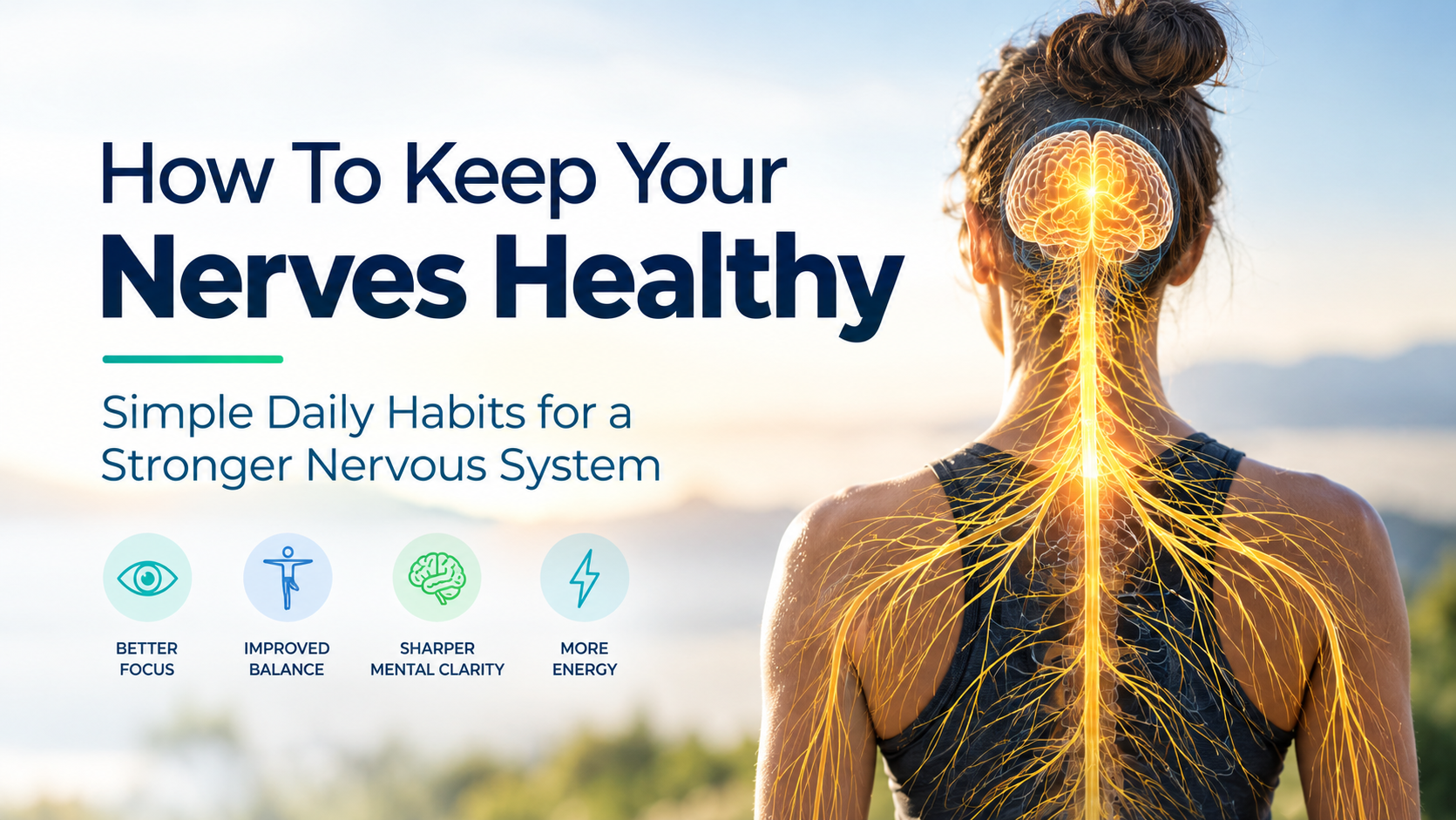
As the NIH’s neurological institute puts it, “all sensations, movements, thoughts, memories, and feelings are the result of signals that pass through neurons.”
All of them. Which means the question of how well those signals are travelling is not a niche concern — it sits underneath balance, coordination, focus, grip, posture and most of what people describe as feeling sharp or not. Keeping the map in service is maintenance, not rehabilitation.
It also fits the broader picture: the National Institute on Aging identifies four types of exercise that matter for health and physical ability, and two of them — balance and flexibility — are the two most people skip entirely in favour of the other two.
Use the whole map: six things, most days
None of this is a workout and none of it takes long. It is variety rather than effort, and that is the point.
1. Your eyes, near and far
The one from the opening. Several times a day, deliberately shift focus from something close to something as far away as you can see, and back. Hold each for a couple of seconds.
Most of us now spend the overwhelming majority of our waking hours looking at things between thirty and seventy centimetres away. The far end of that range barely gets asked for. Add tracking too — follow a moving object with your eyes without moving your head.
2. Your feet, on something other than flat
Shoes and smooth floors do a great deal of your foot’s work for it. Spend some time barefoot. Walk on grass, sand, gravel, anything uneven.
Add toe lifts and heel lifts while you are standing at the kettle — the pathways that lift the front of your foot are among the easiest to let go quiet and among the most useful to keep.
3. Balance, briefly and often
Stand on one leg while you brush your teeth. That is the whole instruction.
When it gets easy, close your eyes — and hold something, because it is genuinely much harder and there is no prize for falling over. Thirty seconds a side, twice a day, is enough to keep something in service that otherwise quietly disappears.
4. Your other side
Brush your teeth with the non-dominant hand. Carry the bag on the other shoulder. Lead with the other foot on the stairs.
It feels clumsy and that clumsiness is exactly the information — that is what an under-asked pathway feels like, and the feeling fades surprisingly quickly once you start.
5. Full ranges, not middles
Once a day, take your main joints through their complete range. Shoulders all the way around. Neck through its full rotation, gently. Hips, ankles, wrists.
Most daily movement happens in the middle third of what we are capable of. The ends of the range are where things go quiet first.
6. Hands
Grip something properly each day — a bar, a heavy bag, a jar lid. And do something fiddly: buttons, an instrument, cooking that requires knife work.
Fine motor control uses a different set of pathways from gross strength, and typing is not a substitute for either.
Why variety beats intensity here
If you take one idea from this page, take this one.
A hard workout asks a lot from a narrow set of pathways. Thirty seconds on one leg with your eyes shut asks a little from a set that gets asked for almost nothing. For nerve function specifically, the second one is doing something the first cannot — which is why someone very fit can still be quietly narrow.
Keep training however you train. This sits alongside it and costs almost nothing.
What makes it hold
Nerves run on the same ingredients as everything else, and the practice above works far better on a body that has the basics in place.
- Oxygen, water and light, in that order. The full version is in the OWL Method and the daily rhythm is in how to support your nervous system naturally.
- Sleep, because repair happens there and nowhere else.
- A system that can settle. Someone permanently braced gets less from everything, which is what the downshift protocol is for.
Those tracks are built out properly for female health and male health inside the membership.
Where home stops
Two different things here, and the distinction matters.
Measurement
Everything above is maintenance you can do without knowing anything specific about yourself. What it cannot tell you is which pathways are actually falling short — that needs testing, pathway by pathway, by someone who knows where each one goes.
That is the 88-nerve assessment at The Nerve Health Institute, explained properly in what is Quantum Neurology. Most people have never had it done once, and once is genuinely informative.
And the part that is not optional
If you have anything that is new, worsening, or on one side only — weakness, numbness, tingling, loss of coordination, changes in vision or speech — that is a physician question and it comes before everything on this page.
Sudden changes of that kind need urgent medical attention, not exercises. I would say exactly that to anyone who asked me, and nothing here is a substitute for being properly assessed.
Start tomorrow
One leg while you brush your teeth. Eyes to the far wall and back a few times. Barefoot for ten minutes. Non-dominant hand for something small.
That is the whole thing, and you have just read it. Variety, most days, for the rest of your life.
If you want it built into a structure rather than remembered, the 28-Day Cell Sparking Challenge is inside the BodyCharger membership. And where circulation and oxygenation are part of your wider picture, that is EBOO Prime.
Frequently asked questions
How can I keep my nerves healthy?
Use the whole map rather than the narrow part of it you use by default. Shift your eyes between near and far, spend time barefoot on uneven ground, balance on one leg daily, use your non-dominant side, take your joints through full ranges, and use your hands for both grip and fine work. Variety matters more than intensity here.
Is this the same as exercise?
No, and it is not a replacement for it. A workout asks a lot from a narrow set of pathways; this asks a little from a set that gets asked for almost nothing. Someone very fit can still be quietly narrow, which is why the two sit alongside each other.
How long does it take?
A few minutes spread through the day, mostly attached to things you already do — brushing your teeth, waiting for the kettle, walking. It is designed to need no extra time at all.
Why does my non-dominant side feel so clumsy?
Because it has been asked to do far less. The clumsiness is information rather than a problem, and it fades surprisingly quickly once you start using it.
When should I see someone instead?
If anything is new, worsening, or on one side only — weakness, numbness, tingling, coordination changes, vision or speech changes — see a physician, and urgently if it came on suddenly. That comes before any of this.
How do I find out which of my pathways are weak?
That needs proper testing rather than guesswork. The 88-nerve assessment at the clinic tests each major pathway individually, and most people have never had it done even once.
Start with one leg
Tomorrow morning, while you brush your teeth. That is the entire first step, and it costs nothing.
When you want the structured version, it is inside the BodyCharger membership.
Dr. Chris Cormier, DC
BodyCharger — at-home protocols for everyday health
Clinic care at nervehealth.com. More on how and why I practise this way at drchriscormier.com.
Spark your cells to optimal longevity.