By Dr. Chris Cormier, DC — Body Chargers
Electrolyte sachets have gone from a sports-bag item to a kitchen-counter item in about three years. They are genuinely useful in certain situations, and in most of the situations people use them, they are an expensive way to do something water and food already do.
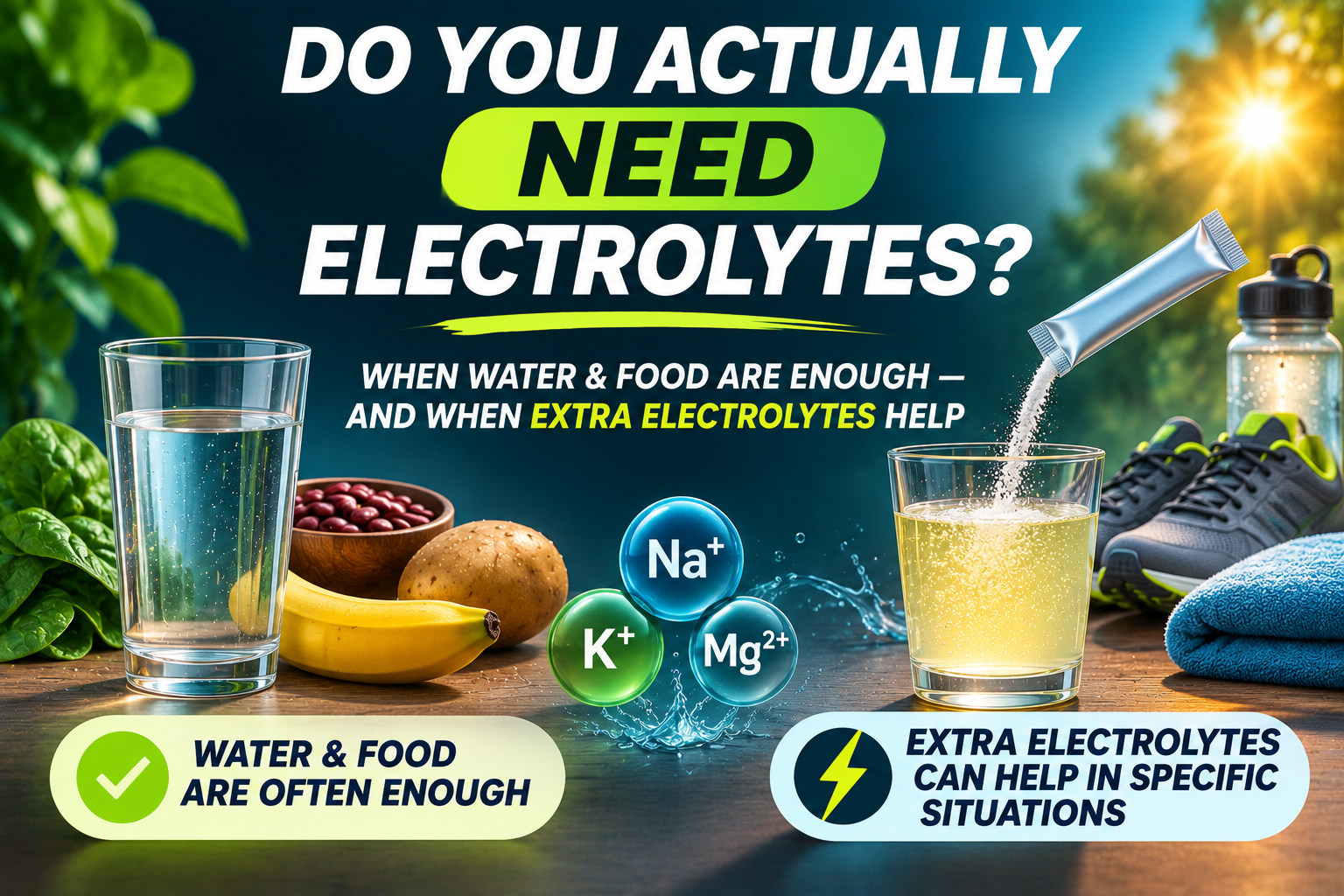
Both halves of that are worth knowing. So when somebody asks do you need electrolytes, this page gives the situations where the answer is a clear yes and the situations where it is a comfortable no.
What electrolytes actually are
Electrolytes are minerals that carry an electrical charge when dissolved in body fluid: mainly sodium, potassium, chloride, magnesium and calcium.
They do real and important work. They hold the balance of fluid inside and outside your cells, they carry the electrical signalling your nerves depend on, and they make muscle contraction possible — including the heart muscle. Nothing on this page is an argument that electrolytes do not matter. They matter enormously. The question is only whether you need to buy them.
Magnesium is one of the five, and worth understanding on its own terms — the clinic covers which version does what in magnesium forms.
When you genuinely do need them
There are clear situations, and in these the answer to do you need electrolytes is straightforwardly yes.
- Illness involving significant vomiting or diarrhoea. This is the strongest case of the lot, because you are losing fluid and minerals quickly and food is not going in reliably.
- Prolonged heavy sweating — long or intense exercise, particularly in heat, and outdoor physical work.
- Heat exposure generally, even without heavy exertion.
- If you are what researchers call a salty sweater. People vary enormously here, losing anywhere from about 200 to 1,800 milligrams of sodium per litre of sweat, and one study found around one in five runners sat at the high end. White marks on dark clothing after training is the everyday sign.
If you are in one of those categories, this page is not telling you to stop. It is telling everybody else something different.
When you probably do not
Sports nutrition researchers and clinicians are fairly consistent on when you do not need electrolytes. If your exercise runs under about seventy-five minutes and is not extremely intense, there is generally no need for electrolyte supplementation at all. A brisk half-hour walk, a yoga session, a moderate hour in an air-conditioned gym — your levels do not move much, and ordinary food covers the difference.
Then there is the sodium arithmetic, which is the part that settles it for most people.
Dietary guidelines put the ceiling at 2,300 milligrams of sodium a day for adults — roughly a teaspoon of salt — and heart-health bodies suggest an ideal nearer 1,500. The average intake in the United States is around 3,400 milligrams.
So for most people, most days, an electrolyte sachet is not topping up a deficit. It is adding to a surplus that already exists.
That is not a scare. Plenty of people can carry that comfortably. It just means the sachet is unlikely to be doing the job it was bought for.
The potassium detail nobody mentions
This one genuinely surprises people, and it is the most useful thing on the page if you are comparing products.
Adults need somewhere around 2,600 to 4,700 milligrams of potassium a day. In the United States, potassium in a supplement is generally capped at 99 milligrams per serving.
Which means the potassium in an electrolyte sachet is, nutritionally speaking, a rounding error. A baked potato or a bowl of beans will contribute more potassium than the sachet by a wide margin, and a banana comfortably outdoes it.
So if potassium is the reason you are buying them, the shopping list is the better purchase.
The cramps question, answered honestly
Muscle cramp is the single most common reason people reach for electrolytes, so it deserves a straight answer rather than a reassuring one.
The link is genuinely contested. There is currently little good evidence that replacing sodium during exercise prevents or delays muscle cramp the way adequate fluid and carbohydrate reliably support performance, and the question remains open among sports scientists.
What that means practically: if cramping is your reason, electrolytes are worth a try and they are not a sure thing. Fatigue, training load, conditioning and simple hydration are all plausible contributors, and it is worth looking at those too. Our guide to how hard should I be exercising is a reasonable place to start, and persistent or severe cramping belongs with a doctor rather than a sachet.
How to tell whether you are actually low
There is no at-home test for this, and the honest answer is that most of the everyday signs are non-specific — fatigue, headache, dizziness and cramp all have a long list of possible causes, and electrolytes are only one entry on it.
What you can usefully pay attention to:
- How much you are actually sweating. Not how hard the session felt — how wet you were at the end of it, and whether it went on for more than an hour.
- Salt marks on dark clothing after training, which is the practical sign of a heavier sodium loss.
- Urine colour across the day. Pale straw is the target; consistently dark suggests you are simply drinking too little, which water fixes.
- Whether symptoms track your heavy days or turn up equally on the days you did nothing. If they turn up regardless, electrolytes are unlikely to be the explanation.
Anything persistent, severe or new belongs with a doctor rather than with a label. That is not a disclaimer, it is the fastest route to an answer.
The fuel tank idea, done properly
A useful way to hold all of this is to think of each mineral as a tank. You want them reasonably full, you do not want them empty, and — the part the marketing skips — you do not want them overflowing either.
The analogy is helpful because it kills the instinct that more must be better. A full tank does not run better than a three-quarter tank, and pouring in more does not store up credit for later. The body holds these minerals within fairly narrow ranges and clears the excess, which is exactly why the question is not how much can I take but whether anything is actually running low.
How to read the label
Four numbers tell you almost everything.
- Sodium in milligrams per serving. Then multiply by the servings you actually have in a day and set it against the 2,300 milligram daily ceiling.
- Potassium in milligrams, with the 99 milligram cap in mind.
- Magnesium in milligrams — and read the elemental figure, for the reasons the clinic explains in magnesium forms.
- Sugar. Many of these products carry a substantial amount, along with sweeteners, flavourings and colours. That is fine if you want it and worth knowing if you do not.
And the habit that applies to everything, not just this: total it across every product you take, because minerals appear in multivitamins, powders and combination formulas as well. The clinic made that case using a different nutrient in vitamin B6 toxicity and nerve symptoms.
The morning glass of mineral water
A pinch of good mineral salt in a glass of filtered water first thing is a pleasant habit, and a number of people in our community swear by it. We are happy to say it is harmless for most people and a reasonable way to start the day hydrated.
We will also be straight about what it is not. The trace minerals in a pinch of unrefined salt are present in genuinely tiny quantities, and they are not a meaningful nutritional source — the marketing around trace mineral counts tends to imply rather more than the amounts justify. What that glass of water mainly does is get you drinking early, which is a good habit on its own merits.
Enjoy it for that. If you have high blood pressure, reduced kidney function or heart failure, check with your clinician before adding salt to anything as a routine.
What food does for free
Every electrolyte on the list is abundant in ordinary food, which is the quiet reason most people are already fine.
- Potassium — potatoes, leafy greens, beans, lentils, bananas, yoghurt.
- Magnesium — nuts, seeds, legumes, whole grains, leafy greens.
- Calcium — dairy, fortified alternatives, tinned fish with bones, leafy greens.
- Sodium and chloride — already in nearly everything, which is the point made above.
A glass of milk and a snack after exercise is a perfectly respectable recovery strategy, and it is the one most sports nutritionists will suggest before a sachet.
Who should take particular care
Most of this is low-stakes. A few situations are not, and they are easy to check in advance.
- High blood pressure, heart failure or reduced kidney function — added sodium and added potassium both matter here, and this is a conversation with your doctor rather than a label-reading exercise.
- Certain medications, including some blood pressure drugs, affect potassium handling.
- Pregnancy, and any diagnosed condition you are actively managing.
If you fall into one of these, that is not a reason to worry — it is a reason to ask once and then stop wondering.
Where this fits in the foundations
Water is one of the three pillars the OWL Method is built on, alongside oxygen and light. Hydration genuinely matters, and the version that matters is drinking enough plain water across the day rather than the version that arrives in a sachet.
If you want to find out whether electrolytes do anything for you personally, treat it as an experiment rather than a purchase: change one thing, keep a note, give it a few weeks. We set that method out in biohacking at home, EBOO Prime covers the measurement side in how do you know if a treatment is working, and Dr. Cormier wrote about why your own impression is the weakest evidence available in I test everything on myself first.
Frequently asked questions
Do you need electrolytes every day?
For most people, no. If you eat a reasonably balanced diet, are not exercising intensely for long periods, and are not working in heat, ordinary food and water cover it. Daily sachets are worth it mainly for people who sweat heavily and regularly.
Do electrolytes help with muscle cramps?
Possibly, and the evidence is weaker than the marketing suggests. There is little good evidence that sodium replacement during exercise prevents or delays cramp, and the question is still debated. Worth a try, not a certainty, and persistent cramping is worth a doctor’s opinion.
How much sodium is in an electrolyte drink?
It varies widely, which is exactly why the label matters. Check the milligrams per serving, multiply by how many you have, and compare it against the 2,300 milligram daily ceiling for adults — bearing in mind average intakes already run higher than that.
Is it better to drink electrolytes or just water?
For everyday life and shorter or moderate exercise, water plus ordinary food. For prolonged heavy sweating, heat or illness with fluid loss, electrolytes earn their place.
Can you have too many electrolytes?
Yes. Sodium, potassium and magnesium can all be overdone, and it matters most for anyone with high blood pressure, heart failure or reduced kidney function. The practical safeguard is to total your intake across every product rather than looking at one label at a time.
Start with the part that is free
Whether or not you need electrolytes, hydration, food and daily movement will do more for how you feel than anything that arrives in a sachet — and our 28-Day Cell Sparking Challenge sequences exactly that, with no equipment and no shopping list.
Become a Body Charger member to follow it, or start with where to start with your health if you would rather ease in.
Spark your cells to optimal longevity.
— Dr. Chris Cormier, DC
Body Chargers