By Dr. Chris Cormier, DC — Founder, BodyChargers by Dr. Chris
Twenty years ago you could barely find a red light device to buy. I know, because I went looking.
Now you can order forty of them before lunch, and most of the people asking me about red light therapy at home are not asking whether it works. They are asking which one to get, because the listings all claim the same things and none of the numbers mean anything to them.
So this is the guide I wish existed. How to read a spec sheet, which numbers are real and which are marketing, what dose actually means, and how to build it into a week in a way you will still be doing in three months.
A Short Version of the Science
Red and near-infrared light are absorbed by an enzyme in your mitochondria, and when that happens the cell produces energy more efficiently. The formal name for this is photobiomodulation, and the mechanism is described in reasonable detail in the literature.
Light sits in the OWL Method — Oxygen, Water and Light — alongside frequency, magnetism and nutrients, which is the framework everything on this platform is built on. You can read the full version on the OWL Method page. The short argument for light is that we evolved outdoors under a sun that is around half near-infrared, and we now spend our lives indoors behind glass that filters most of it out.
That is the whole rationale. The interesting question is not whether light does something — it is whether the device you are pointing at yourself is delivering enough of it.
The Two Numbers That Decide Everything
Dose is the thing. Dose is irradiance multiplied by time.
Irradiance is how much light energy lands on a square centimetre of you per second, usually written as mW/cm². Time is how long you sit there. Multiply them and you get the dose, usually written in joules per square centimetre.
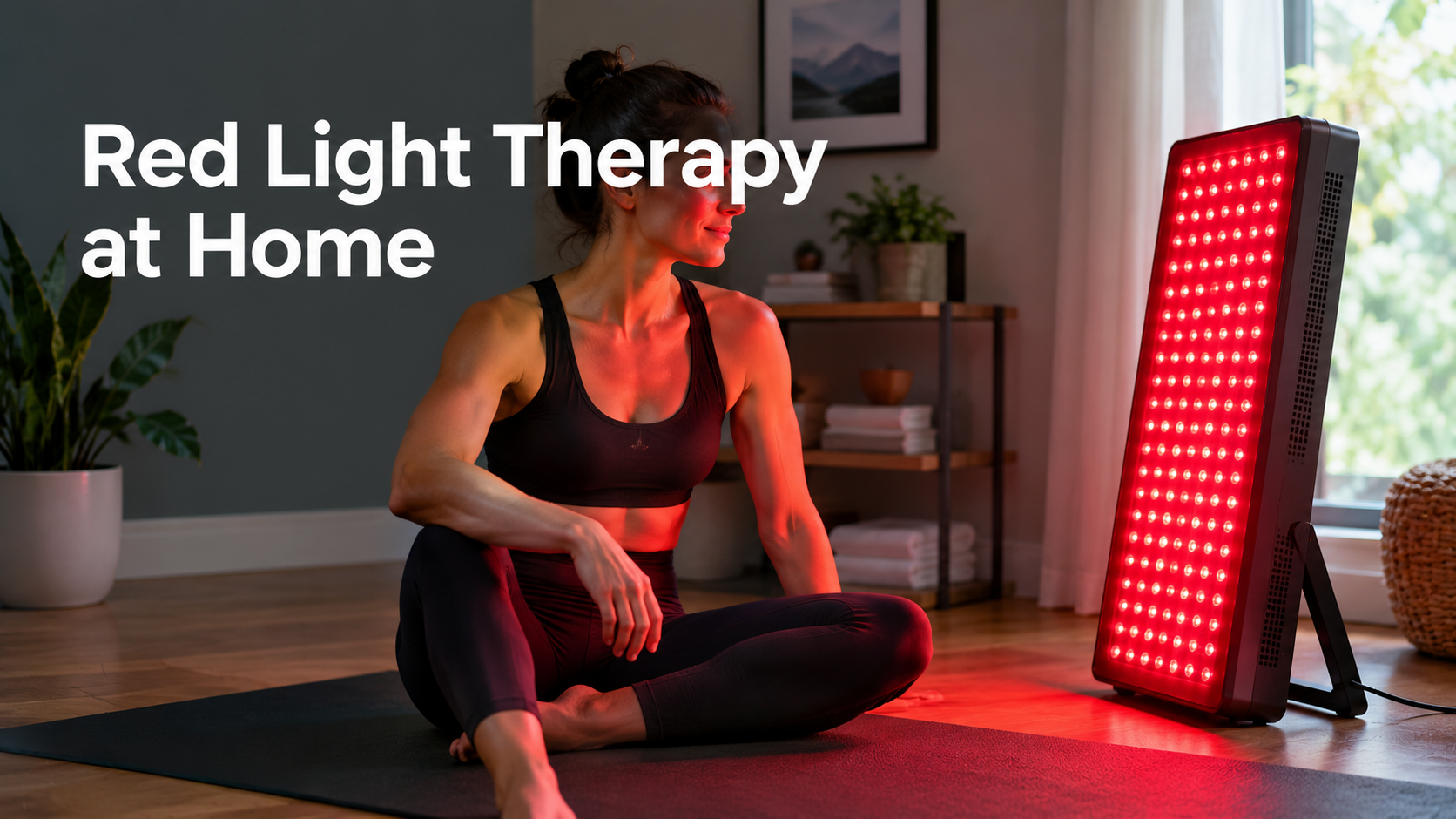
Here is the part that trips everyone up: irradiance falls away fast as you move back from the panel. A device that delivers a strong reading at two inches may deliver a fraction of that at twelve, and almost nothing at twenty-four. Most people set a panel up across the room, sit at a comfortable distance, and wonder why nothing happens.
Which means two things are non-negotiable when you buy. The manufacturer must state irradiance at a stated distance, and you must then actually use the device at that distance. A number with no distance attached is not a specification — it is a decoration.
How Device Specs Get Inflated
I am going to be blunt here, because this is where people waste money.
Irradiance measured at zero distance. Some brands quote a figure taken with the sensor pressed against the lens. It is technically true and practically useless, because nobody treats themselves with their skin touching the diodes. Look for a figure at six inches or twelve.
Total diode wattage. A listing boasting “2,000W of LED power” is adding up the theoretical maximum of every diode. It tells you nothing about what reaches your skin, and it is quoted precisely because it sounds impressive.
Readings taken with ambient light included. Cheap solar-power meters pick up room light. Some spec sheets are generated this way, deliberately or otherwise.
Wavelength padding. Panels advertising six, eight or ten colours look more capable. In practice, red around 660 nanometres and near-infrared around 850 are the workhorses, and extra colours on a full-body panel are mostly there to populate a bullet list.
No third-party verification. A serious manufacturer will publish independent testing of its output. One that only offers its own figures is asking you to take its word for it.
Two more practical tells. Cheap drivers flicker, which some people find uncomfortable and which matters for anyone with a seizure disorder. And a generous return window and a real warranty tell you more about a company than any spec sheet does — businesses that expect returns build better products.
We keep a vetted list on the recommended devices page, and the reason it exists is that I got tired of patients spending three hundred dollars on something that delivers almost nothing at a usable distance.
More Is Not Better, and This Surprises People
Photobiomodulation follows a biphasic dose response. Too little light does nothing. The right amount produces the effect. Past a certain point the benefit flattens out and can go into reverse.
This matters more at home than in a clinic, because at home nobody stops you. The panel is right there, the logic of “a bit more surely helps” is seductive, and there is no appointment slot forcing you out of the room.
My own practice is short sessions several times a week rather than long sessions daily. If the manufacturer gives a protocol for your device at your distance, follow it. If your reaction to that is that it seems too short, that feeling is the thing to ignore.
Building It Into a Week You Will Keep
The programme runs in three levels, and red light sits in a specific place in that order.
Reset. Foundations first — sleep rhythm, hydration, breathing, morning daylight. Red light therapy at home layered on top of four broken hours of sleep is money spent compensating for something free. Start at Reset.
Adjust. Once the foundations are steady, add targeted work — the panel at a consistent distance and schedule, plus frequency protocols where they fit.
Optimize. Build beyond baseline and keep what you have gained.
A workable shape for a week: panel sessions on three or four fixed days rather than “whenever I remember”, at a measured distance you do not change, with a tape measure or a mark on the floor so the distance is not a guess. Morning daylight on every day regardless — the panel does not replace that, and anyone telling you otherwise is selling panels.
Keep one line a day: sleep, energy, how any sore area felt, and whether you did the session. Two months of that tells you whether this is doing anything for you, which is more than most people ever establish.
The 28-Day Cell Sparking Challenge
Inside the community, the 28-Day Cell Sparking Challenge turns the whole framework into one small change a day, in order, without you having to design it.
The reason that matters for red light specifically is that device routines die quietly. Nobody decides to stop. The panel just moves to the corner of the room and then behind a door. A structured sequence with a daily prompt is the difference between a habit at week twelve and an expensive clothes horse.
Stacking It With the Rest
Light is one ingredient, and on its own it is the least interesting version of this.
At home it pairs naturally with breathing work, steady hydration, protected sleep and the frequency programmes on our device range — the DeVita line, which covers nervous system regulation, sleep and digestion from something that fits in a pocket.
At the clinic the same logic runs with heavier equipment: hyperbaric oxygen, EWOT, and EBOO Prime where filtration and oxygenation are appropriate. Different scale, same framework.
Safety at Home
Red light and near-infrared do not carry the skin cancer risk that ultraviolet does, and most people tolerate them well. That is not the same as safe for everyone, and at home there is nobody screening you.
Check with your doctor first if any of these apply:
- Photosensitising medication — some antibiotics, acne medications, diuretics, certain chemotherapy agents, St John’s Wort. This is the most commonly missed item by a wide margin
- A photosensitivity condition such as lupus or porphyria
- Any suspicious or changing skin lesion — do not treat over it, and get it looked at
- Pregnancy — avoid the abdomen
- A seizure disorder — relevant where a device flickers or pulses
- Active cancer treatment — timing and placement go through your oncology team, and light is not applied over a known or suspected tumour site
Wear the eye protection that comes with the device. These are high-output units and your eyes are not the target.
And keep children away from panel sessions unless a physician has specifically advised otherwise.
What a Home Panel Cannot Do
Two things, and I would rather tell you than have you discover them.
It cannot cover your whole body at a controlled dose in ten minutes. A panel treats a region at a time, which is fine for a knee or a shoulder and slow going for everything at once. That is what a full-body bed is for — I use the TheraLight 360 at the clinic at least once a week, and I have written about how it compares in the article on full body red light therapy.
And it cannot tell you where your system is actually running low. At the Nerve Health Institute we test function across the 88 major nerves branching off the brain and spinal cord before we saturate anything with light. A panel pointed at the part that hurts is a reasonable guess. It is not the same as knowing.
That said — a decent panel used consistently beats an excellent clinic bed used occasionally. Dose is cumulative. Consistency is the whole game, and consistency happens at home.
The Honest Limits
Red light therapy does not treat or cure disease. Devices carrying FDA clearance are cleared for narrow indications such as temporary minor pain relief, wrinkle reduction or hair growth — clearance is not approval, and it is not permission to treat a medical condition. If you have a diagnosis, the physician managing it leads.
The evidence is uneven. It is reasonably well supported for skin and wound healing, temporary musculoskeletal pain relief and exercise recovery. It is promising but unsettled for nerve, cognitive and systemic applications, where the trials are small and the dosing varies so much between studies that comparing them is genuinely difficult.
It does not replace sunlight. Morning daylight does something for your circadian rhythm that no panel reproduces, and that affects your sleep, which affects everything else.
And it does not work for everyone. Some people notice a clear difference quickly. Some notice nothing at all. I cannot tell you in advance which you will be, and anyone who says they can is guessing.
BodyChargers is a coaching and education platform. It is not a doctor-patient relationship and it does not treat medical conditions.
The Short Version
Red light therapy at home works if the device does and if you use it properly. Buy on verified irradiance at a stated distance, not on diode wattage or colour count. Use it at that distance. Keep sessions short and regular rather than long and sporadic. Get the foundations in place first, because they decide how much anything else can give you.
None of that is dramatic. All of it compounds.
Spark your cells to optimal longevity.
— Dr. Chris Cormier, DC
More on how I think about this work at drchriscormier.com.
Frequently Asked Questions
Does red light therapy at home actually work, or do I need a clinic?
It works if the device delivers a real dose and you use it at the distance the manufacturer specifies. A decent panel used three or four times a week beats an excellent clinic bed used occasionally, because dose is cumulative. What a clinic adds is whole-body coverage in one short session and an assessment of where your system is actually running low.
What should I look for when buying a panel?
Irradiance stated at a specific distance — six or twelve inches, not zero. Red around 660nm and near-infrared around 850nm. Third-party verification of the output rather than the manufacturer’s own figure. Minimal flicker. A real warranty and a generous return window. Ignore total diode wattage entirely; it is a marketing number.
How long and how often should I use it?
Shorter and more regular beats longer and occasional. Photobiomodulation has a biphasic dose response, so past a certain point more exposure stops helping and can work against you. Follow the protocol for your device at your distance, and resist the instinct that more must be better.
Which wavelengths matter?
Red at roughly 660 nanometres for surface tissue and near-infrared at roughly 850 for deeper penetration. Those two do the work. Panels advertising six or eight colours are generally padding the feature list rather than adding anything useful.
Is it safe to use at home without supervision?
For most people, yes, with eye protection and sensible dosing. Check with your doctor first if you take photosensitising medication — some antibiotics, acne medications and chemotherapy agents among them — or if you have a photosensitivity condition, are pregnant, have a seizure disorder, or are in active cancer treatment. Never treat over a suspicious skin lesion.
Can it replace getting outside?
No. Morning daylight anchors your circadian rhythm in a way no panel reproduces, and sleep quality affects everything else you are trying to improve. Use the panel in addition to daylight, never instead of it.
Does it treat medical conditions?
No, and I will not suggest otherwise. Cleared devices are cleared for narrow indications like temporary minor pain relief. This platform is education and coaching, and anything you are being treated for stays with your physician.
Start Charging Your Cells Today
Join for the vetted device list, the OWL Method, the 28-Day Cell Sparking Challenge and protocols you can run from home.Join BodyChargers → bodycharger.com/join/