By Dr. Chris Cormier, DC — BodyCharger
You know the state. You are tired enough that your eyes hurt, and still completely unable to stop.
You sit down and your mind immediately produces a list. You lie down and it produces a better list. Exhausted and wired at the same time is one of the most common things people describe to me, and it is also one of the most fixable.
This page is a protocol you can run at home. Twenty minutes when you have them, sixty seconds when you do not.
Why trying harder makes it worse
First, something that takes the pressure off.
When you are already in a high-alert state, instructing yourself to calm down is the single hardest version of the task. You are asking the quieter system to overrule the louder one, by force, at the exact moment the louder one is winning.
So people sit down to relax, find their mind racing, decide they are bad at this, and give up. That is not a character flaw. It is what happens when you attempt a difficult skill under the worst possible conditions.
The techniques themselves are sound — NIH’s complementary health center notes that mindfulness meditation “may help reduce insomnia and improve sleep quality.” The method is not the problem. The starting point is.
The principle the whole protocol rests on
Two things reliably move someone out of a wired state, and neither of them is effort.
- Reduce the input. Less for your system to process means less reason for it to stay on duty.
- Give it something to follow. Generating calm from nothing is hard. Synchronising with something steady is much easier.
Following is easier than generating.
That is worth remembering because it reframes everything below. You are not trying to force a state. You are setting up conditions and then getting out of the way.
And a state is a physical thing, not a mood. An EEG measures the electrical activity of the brain — the tiny signals brain cells use to talk to each other — and those “brain waves are faster when you are awake and slower in certain stages of sleep.” Alert and restful are different rates, which means they respond to physical conditions rather than to instructions.
The 20-minute downshift
This is the version to run when you have the time. It is the same sequence every time, which is the point — familiarity is part of what makes it work.
1. Cover your eyes
Not just closed. Covered. A sleep mask, a folded cloth, anything that blocks light properly.
A large share of your alertness is driven by what you are seeing, and while your eyes are open and scanning, part of your system stays on duty. This step does more than any other on the list and it costs almost nothing.
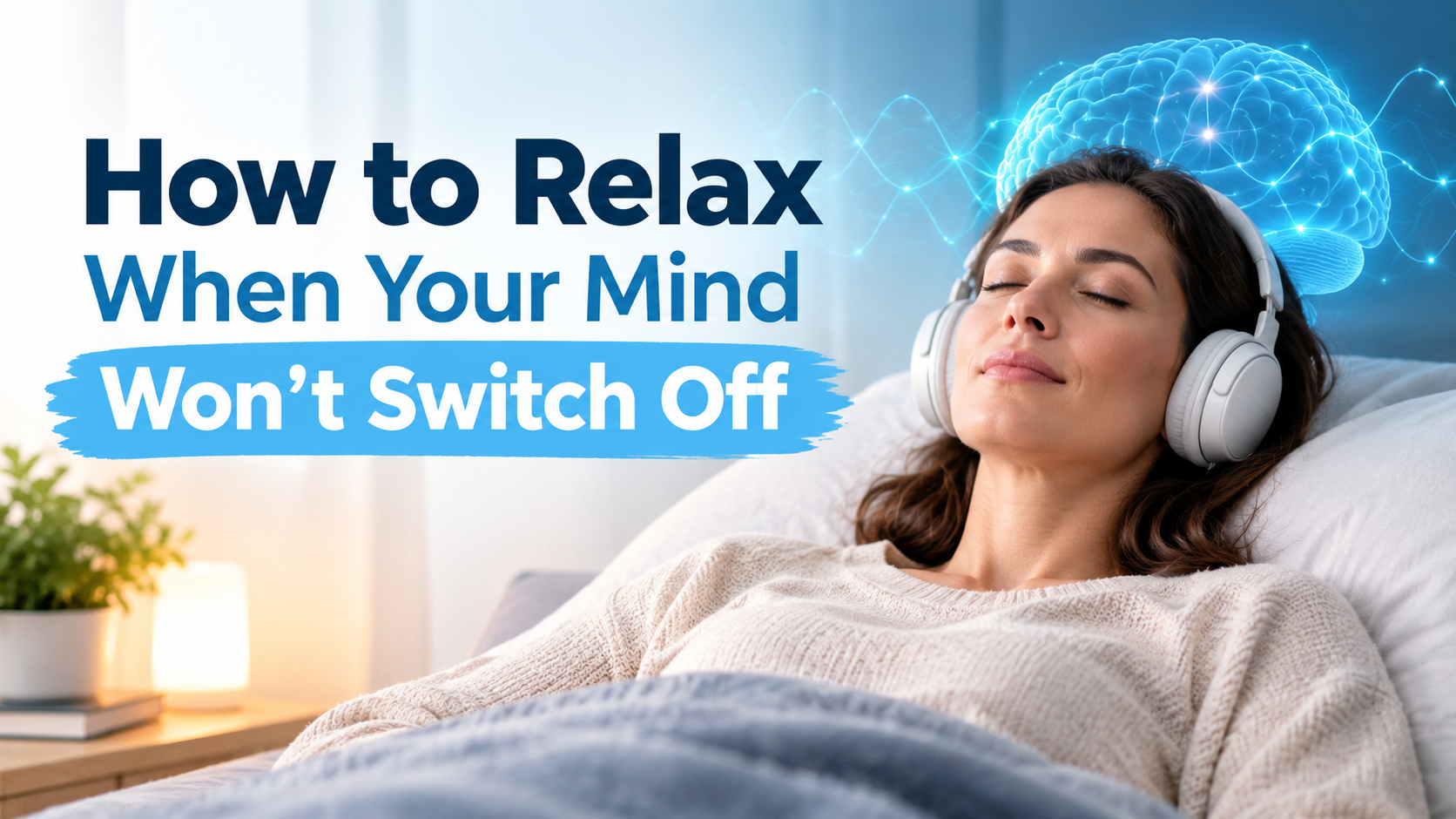
2. Put on closed-ear headphones
A quiet room is not a controlled room. A car outside, a voice down the hall, a door — your attention will find something.
Closed-ear headphones remove the escape route, and they are also the only way any sound or frequency-based approach gets delivered accurately. Earbuds are better than nothing. Over-ear is better.
3. Get horizontal, or close to it
Lie down or recline properly. Holding yourself upright is work, and your system knows it. Legs supported if you can.
4. Two minutes of long exhales
In slowly, out more slowly still, with the out-breath clearly longer than the in-breath. Do not count obsessively — just make the exhale the long part.
This is the most direct voluntary access you have to the calming side of the nervous system, and it works even when your head is busy. Two minutes is enough to start the shift.
5. Then stop steering
This is the step people skip and it is the one that matters most.
After those two minutes, stop managing anything. Let the sound carry it. Your mind will wander — that is fine and it is not a failure. You are not meditating and you are not supposed to be concentrating. Your only job is to have stopped.
If you are using a frequency or neuroacoustic programme, this is exactly where it does its work. We cover which tools we use and how to run them properly inside the membership.
6. Come up slowly
Do not leap straight back into the day. Sit for a minute. Drink some water. The transition out matters nearly as much as the one in.
The 60-second version
For the days when twenty minutes is not happening. Everyone has days like that and a protocol you cannot run is not a protocol.
- Close your eyes. Cover them with your palms if you can.
- Six slow breaths. Out longer than in, every time.
- Unclench your jaw and drop your shoulders on the last two.
It will not take you as deep. It will reliably take the edge off, and it can be done in a car park, a bathroom, or between two meetings. Done often, the short version is worth more than a perfect long version you never do.
When to run it
Three moments where it earns its place:
- The afternoon wall. Instead of a third coffee. You will get more from the rest of the day.
- The handover. Between finishing work and being with people. This is the one that changes households.
- Before bed. Not in bed — before it. Your body is built to change gear gradually, and this is the gradual part. The rest of the setup is in how to sleep better naturally.
This is training, not a trick
A single session feels good. That is not the main benefit.
Your nervous system has two sides. The alert, driven side, and the calming, digesting, repairing side. Most people have a very well-developed first side and a second side that has not been asked to do much in years.
What I want for everyone is both sides strong — able to rev all the way up when life calls for it, and able to come all the way back down afterwards. The second side is trainable, and running a downshift daily is how you train it.
Which is exactly why the 28-Day Cell Sparking Challenge runs for four weeks rather than a few days. Capacity builds with repetition, not with intensity.
What makes it hold
A downshift works better on a body that has the basics in place. None of this is a prerequisite — start the protocol today regardless — but it is why some people get far more from it than others.
- Sleep, because it is where the repair happens.
- Water and light, because they set the rhythm you are trying to work with rather than against. Both are in the OWL Method.
- Daily movement, because a body that has been used all day settles more easily than one that has not.
The full daily version of all of that is in how to support your nervous system naturally, and the tracks for female health and male health build on it.
When at-home is not the whole answer
Straight with you, because it is the honest edge of what a platform can do.
If you run this consistently for a few weeks and still cannot settle, that is useful information rather than a dead end — it usually means something structural is worth looking at properly. That is the 88-nerve assessment and the in-person work at The Nerve Health Institute, where autonomic balance is one of the most common findings.
Where circulation and oxygenation are part of the wider picture, that is EBOO Prime. And more on how I came to practise this way is at drchriscormier.com.
Frequently asked questions
How do I relax when my mind will not switch off?
Stop trying to calm your mind and change the conditions instead. Cover your eyes, put on closed-ear headphones, lie down, and spend two minutes making your exhale longer than your inhale. Then stop steering and let it happen. Forcing calm is the hardest version of the task.
Why am I exhausted but unable to stop?
Because the alert side of your nervous system has been running constantly while the calming side has not been asked to work in a long time. It is a capacity that has gone quiet rather than disappeared, and it is trainable.
How long does the downshift take?
Twenty minutes for the full version. There is a 60-second version for days when that is not possible, and done often the short one is worth more than a perfect long one you never run.
Do I really need an eye mask and headphones?
They are the two highest-value items in this whole protocol and both are inexpensive. Covering your eyes removes the biggest single driver of alertness, and closed-ear headphones remove your attention’s escape route.
Is this the same as meditation?
No, and that is the point. You are not concentrating, observing or practising anything. Your only job is to have stopped — which is why it works for people who have tried meditation and concluded it was not for them.
How soon will I notice a difference?
Individual sessions often feel different straight away. The underlying capacity builds over weeks, which is why we run it as a 28-day block rather than a few days.
Run it today
Eye mask, headphones, twenty minutes. Or sixty seconds and six long exhales if that is what today allows.
When you want it built into a structure rather than remembered, the 28-Day Cell Sparking Challenge is inside the BodyCharger membership.
Dr. Chris Cormier, DC
BodyCharger — at-home protocols for everyday health
Clinic care at nervehealth.com. More on how and why I practise this way at drchriscormier.com.
Spark your cells to optimal longevity.