By Dr. Chris Cormier, DC — BodyCharger
Nobody misses a dose on purpose. That is the first thing worth saying, because most advice on this subject is written as though they do.
People miss doses because they stayed at a friend’s house, because the school run changed, because the bottle was in the other bag, or because a run of good weeks quietly made it feel less urgent. These are not character failures. They are system failures — and systems are fixable in an afternoon.
Why this is worth an afternoon
For a lot of conditions, a missed dose is a nuisance. For some, it is the single most consequential thing in the whole management plan.
Epilepsy is the clearest example. On clinical lists of seizure triggers, missed medication sits at the top — above stress, above flashing lights, above everything else. And the stakes are high: WHO reports that up to 70% of people living with epilepsy could become seizure free with appropriate use of anti-seizure medicines, and that people with epilepsy face up to three times the risk of early death compared with the general population.
Seven in ten is what the medication achieves. The job of your household is to make sure it never gets interrupted.
The same logic applies, with different numbers, to blood pressure medication, thyroid medication, transplant medication, and anything else where the effect depends on a steady level rather than a dose at a time. If you are on something daily and essential, this page is for you.
The principle: stop remembering, start anchoring
Memory is the wrong tool for this job. It works fine on ordinary days and fails exactly on the unusual ones — which is to say, it fails when your routine changes, which is precisely when you are most likely to miss.
What works instead is attaching the dose to something that happens anyway. You already brush your teeth, make coffee, feed the dog, plug your phone in at night. Those things survive a chaotic week because they are not being remembered either — they are just what happens.
Pick the most unshakeable one you have and put the medication physically there. Not in the cupboard near it. There.
The systems, in order of how much they help
Make it visible, where the anchor happens
Out of sight is the main cause of missed doses, and the fix is free. Next to the kettle, on top of the phone charger, beside the toothbrush.
If you have children in the house and visibility is a safety concern, a high shelf in the same room still beats a different room entirely — keep it in the place the habit happens, just out of reach.
Use a weekly organiser, because it answers the real question
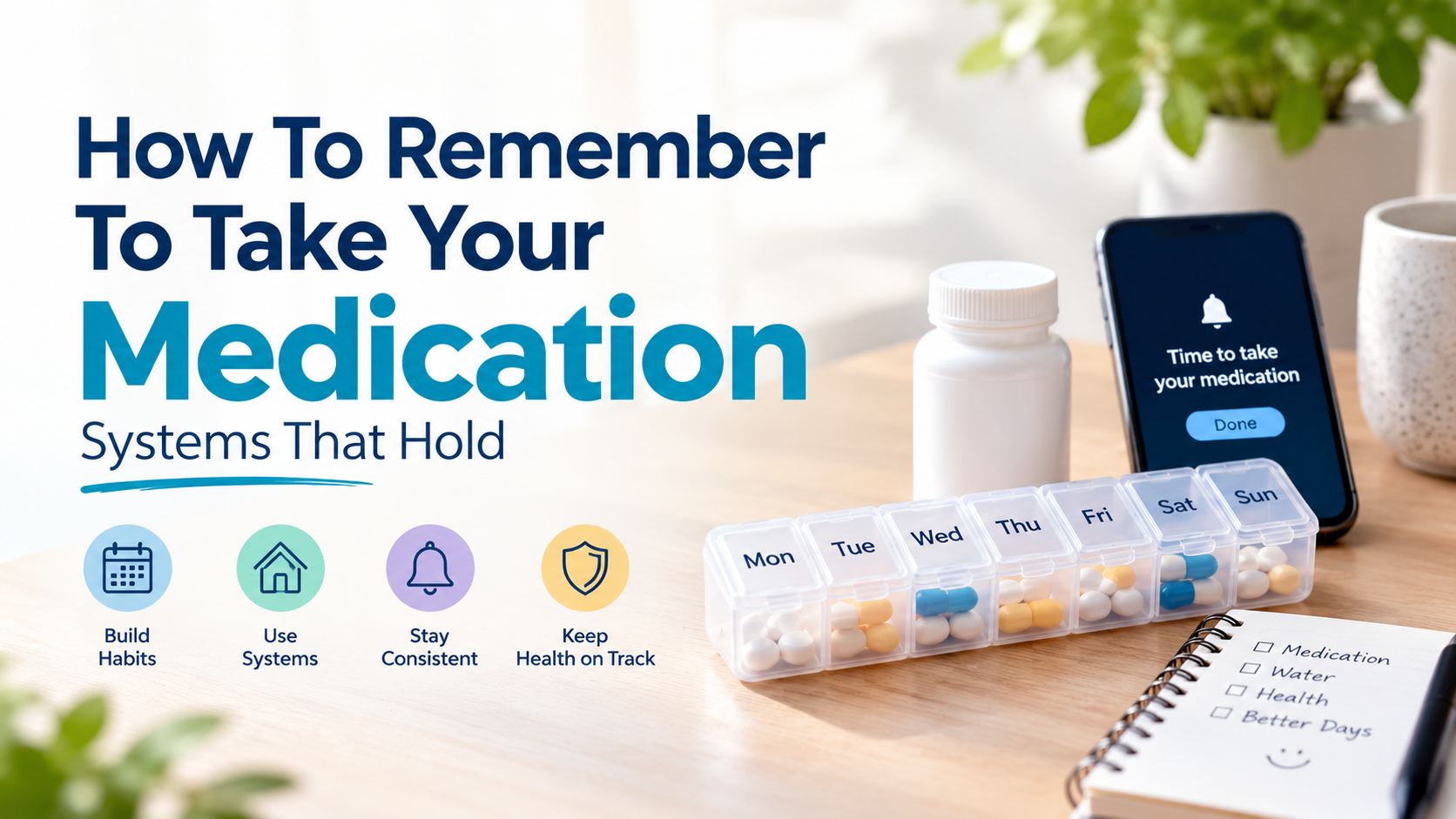
The genuinely useful thing about a seven-day box is not the reminder. It is that it answers “did I already take it?” — which is the question that causes most of the anxiety and most of the accidental doubling.
A glance tells you. Fill it the same day every week, and anchor that to something too — Sunday evening, after dinner.
Set an alarm, and make it a specific one
A repeating phone alarm works, with one refinement: label it with the actual action rather than “medication.” An alarm that says take the blue one now gets acted on. One that says “meds” gets dismissed while you are driving and then forgotten.
Have a travel plan before you travel
A huge share of missed doses happen away from home. Keep a small spare supply in the bag you actually take places, rather than packing from the main supply each time — packing is a step that can be forgotten; already being in the bag is not.
For longer trips, time zones matter and the answer depends on the medication. That is a question for your pharmacist before you go, and they are usually delighted to be asked.
Build a refill buffer
Running out is a system failure with a calendar solution. Order when you open the last week’s worth, not when you reach the last few days. One recurring reminder solves it permanently.
Tell one other person
A partner, a parent, a housemate, a friend. Not to nag — just so somebody else in the world knows the routine and will notice if it slips during a hard week.
The question everybody has: what if I miss one?
Ask your pharmacist or prescriber what to do for your specific medication, ideally before it happens rather than at eleven at night.
The right answer varies genuinely between medications — it is not a general rule, and doubling up is not automatically safe. Your pharmacy will tell you in thirty seconds and it is a free phone call. Write the answer down and put it where the medication lives, so that the plan exists before the moment does.
And if doses are being missed often, or the medication is difficult for any reason — side effects, cost, timing, the grind of it — that is a conversation for the team treating you rather than something to solve alone. Those are solvable problems and they would far rather hear about it.
The two other things you can influence
If you are managing a condition where triggers matter, adherence is the first lever and these are the next two.
Sleep, especially the consistency of it
Sleep deprivation sits second on the trigger list behind missed medication, and it is the other thing a household can genuinely influence.
The levers are environmental rather than motivational: a cool room around 65 to 68°F, properly dark, with air moving, lights down an hour before bed, and the same wind-down in the same order nightly. Regularity of timing matters as much as total hours — the full seven-night build is in how to sleep better naturally.
Stress load, and the ability to come down from it
“Reduce your stress” is useless on its own. The actionable version is training the capacity to settle: cover the eyes, control the sound, and breathe with a longer out-breath than in-breath for two or three minutes.
The fuller protocol is in how to relax when your mind will not switch off, and the daily rhythm that supports it is in how to support your nervous system naturally.
While we are on households: a few safety habits
If somebody in your home has a condition that can cause sudden loss of awareness, a handful of ordinary adjustments reduce risk considerably, and none of them require anybody to live differently.
- Showers rather than baths, and never lock the bathroom door — a wedge or an engaged sign does the same job.
- Nobody swims alone, ever, and whoever is with them knows.
- Back rings on the hob and pan handles turned inward.
- Soft flooring where practical, and corner guards on low tables.
- A medical bracelet, which is the first thing emergency responders look for.
And learn seizure first aid properly, even if nobody in your house has epilepsy. The CDC sets out the full steps — including the things not to do, which is where most people go wrong — and we have written it up alongside the trigger detail at The Nerve Health Institute.
What we do not do
- We do not diagnose or treat epilepsy or any other condition requiring prescribed medication.
- We never advise anyone to stop, reduce or change medication. Not for any reason. That belongs with your prescriber.
- Nothing we offer is a substitute for a prescribed treatment. What is on this page is the household layer that protects it.
- We do not ask you to choose. Keep every appointment you have.
If you want it as a structure
Everything above works. What makes it stick is doing it once, properly, rather than intending to.
The 28-Day Cell Sparking Challenge sequences the daily practices so the deciding is already done, built on the OWL Method — oxygen, water and light. The tracks for female health and male health sit inside the membership, and if you are rebuilding after a difficult stretch, how to recover from a long illness covers the pacing.
Frequently asked questions
How can I remember to take my medication every day?
Stop relying on memory and anchor the dose to something that already happens — the kettle, the toothbrush, the phone charger — with the medication physically in that spot. Add a weekly organiser so you can see whether you have taken it, a labelled alarm naming the actual action, and a spare supply kept permanently in your travel bag.
What should I do if I miss a dose?
Ask your pharmacist or prescriber what to do for your specific medication, ideally in advance. The correct answer varies between medications and doubling up is not automatically safe. Write their answer down and keep it where the medication lives.
Why do missed doses matter so much with epilepsy?
Because missed medication sits at the top of clinical seizure trigger lists, above stress and flashing lights. WHO reports up to 70% of people with epilepsy could become seizure free with appropriate anti-seizure medicines, and that people with epilepsy face up to three times the risk of early death — so uninterrupted treatment is the most protective thing there is.
Can I stop medication once I have been well for a long time?
Never change prescribed medication without the prescriber. A long good run is usually the treatment working rather than evidence it is finished. If the medication is difficult for any reason, raise it with them — that is a solvable conversation.
What home safety changes help if someone can lose awareness suddenly?
Showers rather than baths with the door unlocked, never swimming alone, back rings on the hob with handles turned in, soft flooring and corner guards where practical, and a medical bracelet. None of them require anyone to live differently.
Does BodyCharger treat epilepsy?
No. We do not diagnose or treat it and we never advise changing medication. What we offer is the household layer around a treatment plan — adherence systems, sleep, stress load and home safety.
Start this evening
Pick your most unshakeable daily habit, and move the medication physically to where it happens. Then set one labelled alarm and put a spare supply in your travel bag.
Fifteen minutes, no cost, and it removes the commonest reason the whole plan slips. When you want the structured version of everything around it, the 28-Day Cell Sparking Challenge is inside the BodyCharger membership.
Dr. Chris Cormier, DC
BodyCharger — at-home protocols for everyday health
Clinic care at nervehealth.com. Circulation and oxygenation at ebooprime.com. More on how I practise at drchriscormier.com.
Spark your cells to optimal longevity.