By Dr. Chris Cormier, DC — BodyCharger
The treatment finishes. Somebody tells you the good news. And then you go home and discover you still feel like a shadow of yourself.
Almost nobody is warned about this part, and it catches people badly, because the natural reading is that something has gone wrong. Usually nothing has gone wrong at all. You have simply been ill for a long time, and bodies do not come back on the same day the treatment ends.
First, the one thing that is not optional
Everything on this page is for after your treatment is complete and the people looking after you are happy.
If you are still partway through a course of medication, finish all of it, exactly as prescribed, even if you already feel much better. Feeling better early is the treatment working, not a sign it is no longer needed. For a long antibiotic course in particular, WHO is explicit that stopping early or without medical advice can allow resistance to develop, and the CDC says the same: taking all of the medication as directed is what helps a person recover.
And if anything about the course is hard — side effects, cost, the sheer length of it — tell the team treating you. Those are solvable problems and they would much rather hear about it. Nothing here replaces any of that.
Why you feel like this
It helps to know what is actually behind it, because it stops you reading the tiredness as failure.
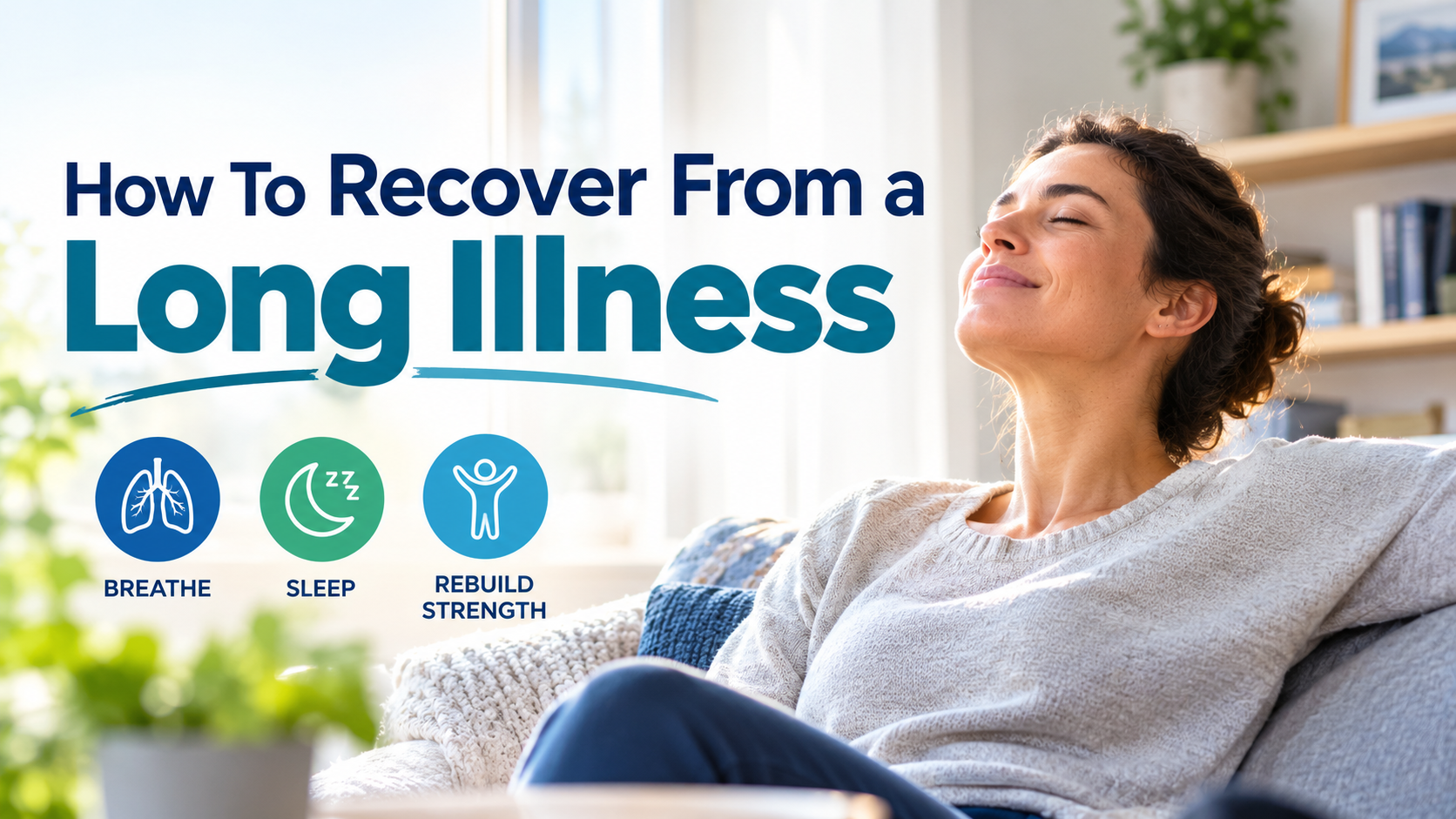
A long illness leaves four things behind, and they are all ordinary:
- Breathing that got into a shallow habit. Especially after anything respiratory. The pattern often stays long after the reason for it has gone.
- Sleep that stopped being restorative. Months of broken nights leave habits and a bedroom that drifted.
- Strength and conditioning that drained away. This happens faster than people expect and comes back slower than they hope.
- A system still braced. Being unwell for a long time keeps you on alert, and alert is expensive to run.
None of those is a complication. They are the ordinary aftermath of being seriously unwell, and every one of them responds to patient, structured work.
The mistake almost everybody makes
Before the plan, the thing I most want you to avoid.
Pace to your average day, not to your best one.
What happens otherwise is predictable. You get a genuinely good day, you feel like yourself for the first time in months, and you do everything you have been missing. Then you lose the next three days, conclude you have gone backwards, and start the cycle again.
You have not gone backwards. You overspent. The fastest recovery belongs to the person who does slightly less than they could on the good days and keeps going on the flat ones — which is dull advice and completely correct.
Stage one: the first fortnight
The goal here is not progress. It is a floor to build on.
Fix the bedroom first, because it is the only change on this page that works while you are asleep. Cool, around 65 to 68°F. Properly dark — most bedrooms are not, and a cheap sleep mask settles it in one night. Air actually moving. Lights down an hour before bed, and the same wind-down in the same order every night. The full build is in how to sleep better naturally.
Then two small things daily, neither of which requires energy you do not have:
- Get outside in daylight, early. Even five minutes by the door. This sets the rhythm that decides how you feel at two in the afternoon.
- Drink water first thing. Everybody wakes dehydrated, and most people reach for coffee instead.
That is the whole of stage one. If you do nothing else for two weeks, do these.
Stage two: weeks three to eight
Now you add breathing and gentle movement, in that order.
Retrain the breath
If you have been coughing or short of breath for months, the shallow upper-chest pattern has become the default. Twice a day, for two or three minutes:
- Through the nose, not the mouth.
- Into the lower ribs and belly, so your shoulders stay still.
- Slower, with the out-breath longer than the in-breath.
That last one also recruits the calming side of the nervous system, which is the thing still stuck on alert. The fuller protocol is in how to relax when your mind will not switch off, and the reason oxygen delivery matters so much is covered at EBOO Prime.
Movement, deliberately underdone
Start below what you think you can manage. A ten-minute walk, flat, same time each day. Finish wanting to do more — that is the whole technique, and it is what stops the boom-and-bust cycle before it starts.
Add a minute or two a week rather than a block at a time. For variety that rebuilds balance, co-ordination and full ranges rather than just fitness, how to keep your nerves healthy has the small daily pieces.
Eat to rebuild, not to restrict
Appetite is often one of the last things to return. The useful version is adding rather than removing: regular meals at predictable times, something substantial with real protein at breakfast, water visible and within reach. This is not the moment for any kind of restriction — your body is rebuilding tissue and it needs materials. If appetite or weight is a concern, raise it with your doctor rather than managing it alone. Gentle support for the body’s own clearance pathways is in how to support your natural detox.
Stage three: from about week nine
This is where you start asking for a bit more, and where most people are pleasantly surprised.
Add some mild effort — a hill on the walk, a few flights of stairs, light resistance work. The test is how you feel the next morning, not how you feel during it. If the next day is fine, hold there for a week before adding again. If the next day is rough, you have found your current ceiling, which is genuinely useful information rather than a setback.
Expect the mental side to lag behind the physical. Concentration and word-finding often come back last, and that is common enough to be unremarkable — the everyday version of it is covered at EBOO Prime.
The tracks for female health and male health pick up from here inside the membership.
When to stop and ask
Recovery should trend upward over weeks, even with flat days in between.
If it is not — if you are going sideways for weeks, or new symptoms appear, or something that had settled comes back — that is worth a conversation with your doctor rather than more patience. Going back to ask is not a failure of recovery; it is part of doing it properly. And anything new — a cough that persists for three weeks or more, fever, night sweats, weight loss you did not intend — gets seen rather than waited out.
If you want it as a structure
The three stages above work. What usually goes wrong is that a person recovering from months of illness is asked to make decisions daily about how much to do, and decisions are exactly what they have least of.
The 28-Day Cell Sparking Challenge sequences the daily practices so the deciding is already done, and the framework underneath it is the OWL Method — oxygen, water and light first, which is precisely the right order for rebuilding.
If your recovery followed a long infection and you want nerve function measured properly rather than estimated, that is the clinic side: recovering from tuberculosis at The Nerve Health Institute.
Frequently asked questions
How long does it take to recover from a long illness?
Longer than most people are told, and it varies widely. A useful expectation is weeks of gradual rebuilding rather than days, with flat days mixed in. What matters more than the timeline is the trend: steady improvement over weeks, even if individual days vary.
Why am I still exhausted after my treatment finished?
Because a long illness leaves four things behind — shallow breathing habits, unrestorative sleep, lost conditioning, and a nervous system still on alert. None of those resolve on the day the last tablet is taken. All of them respond to patient, structured work.
Should I push through the tiredness?
No. Pace to your average day rather than your best one. Doing everything on a good day and losing the next three is the most common pattern there is. Finish each session wanting to do a little more.
Can I stop my medication once I feel better?
No — finish the full course exactly as prescribed. Feeling better early is the treatment working. WHO is explicit that stopping a long antibiotic course early or without medical advice can allow resistance to develop. If the course is difficult for any reason, tell the team treating you.
What should I eat while recovering?
Add rather than subtract. Regular meals at predictable times, something substantial with real protein at breakfast, water within reach. Your body is rebuilding tissue and needs materials, so this is not the moment for restriction. Raise any appetite or weight concerns with your doctor.
When should I go back to my doctor?
If recovery goes sideways for weeks rather than trending upward, if new symptoms appear, or if something that had settled returns. Anything new — a cough lasting three weeks or more, fever, night sweats, unintended weight loss — gets seen rather than waited out.
Start with tonight
Cool room, dark room, air moving, same wind-down in the same order. Tomorrow, daylight by the door and a glass of water before the coffee.
That is stage one, it costs nothing, and it is the floor everything else gets built on. When you want the structured version, the 28-Day Cell Sparking Challenge is inside the BodyCharger membership.
Dr. Chris Cormier, DC
BodyCharger — at-home protocols for everyday health
Clinic care at nervehealth.com. Circulation and oxygenation at ebooprime.com. More on how I practise at drchriscormier.com.
Spark your cells to optimal longevity.