By Dr. Chris Cormier, DC — BodyChargers
There are two ways to get this wrong, and almost everybody picks one of them.
The first is going far too hard. Three brutal sessions, aching for four days, and quietly never going back. The second is a gentle stroll with the phone in hand, which is pleasant and does very little. Both end in the same place — the conclusion that exercise does not work for you.
The useful zone sits between them, and you do not need a device to find it.
The ten-second test that settles it
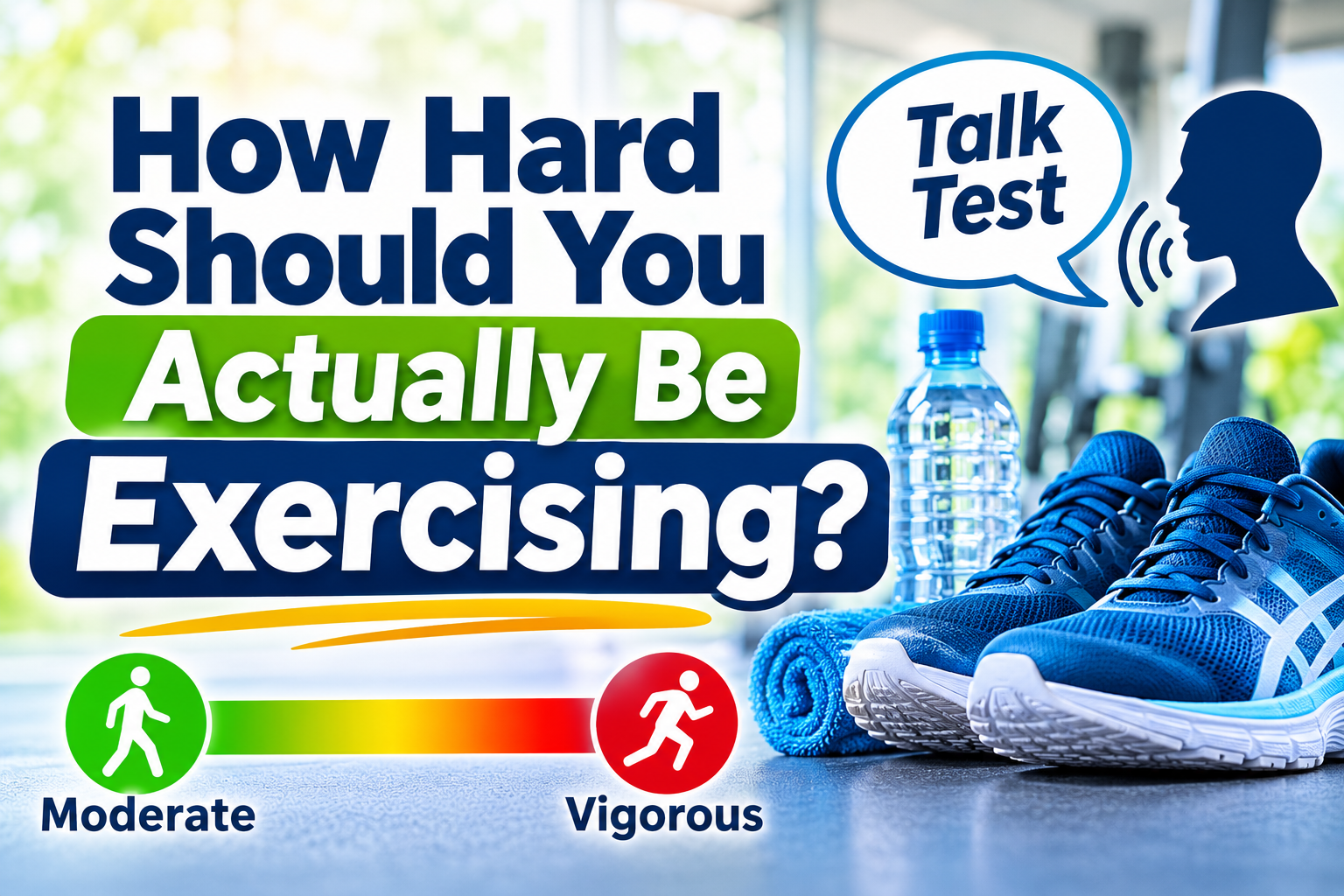
No watch, no chest strap, no app. Just try to talk.
at moderate intensity you can still hold a conversation, but you cannot sing. At vigorous intensity, you can manage a few words before you need to pause for breath.
If you can sing, go a bit harder. If you cannot speak a sentence, ease off. That is the whole instrument.
What makes this better than a heart rate number is that it adjusts itself. It accounts for how you slept, whether you are coming down with something, how hot it is, and what your fitness is today rather than what it was in January. A target heart rate cannot do any of that.
What moderate actually looks like
People consistently overestimate what counts, so here are the CDC’s own examples.
Moderate intensity includes brisk walking at around three miles an hour or faster, water aerobics, cycling under ten miles an hour on mostly flat ground, doubles tennis, ballroom dancing and general gardening.
Vigorous includes jogging or running, swimming laps, singles tennis, cycling at ten miles an hour or faster, jumping rope, heavy digging, and hiking uphill or with a loaded pack.
Notice how ordinary the moderate list is. Gardening counts. Dancing counts. The bar for useful is considerably lower than most people assume, and the bar for consistent is considerably higher.
And how much of it
At least 150 minutes of moderate aerobic activity a week for adults, or at least 75 minutes of vigorous activity — with 300 minutes of moderate activity bringing additional benefit, or 150 vigorous, or an equivalent mix. Plus muscle strengthening on two or more days a week.
A hundred and fifty minutes sounds like a lot until you divide it. That is just over twenty minutes a day, or five sessions of half an hour, or three brisk walks and a long one at the weekend. Put like that it stops being a project and becomes a scheduling question.
Why moderate and often beats hard and occasional
For most people who are not already training seriously, this is the more important decision of the two.
Hard sessions are satisfying and they are also expensive — in recovery time, in soreness, and in the willingness to do the next one. A session you dread is a session you will eventually skip, and consistency is what actually accumulates.
There is a physiological version of this too. Sustained moderate effort keeps circulation elevated for a meaningful stretch of time, which is what gets blood — and everything it carries — into tissue that sees very little during a sedentary day. Delivery follows demand, and demand needs to last long enough to matter. The fuller version of that argument is in how to increase oxygen in your body naturally.
If you are starting from very little
Then the talk test is still your instrument, and the number to lower is the duration rather than the intensity.
Ten minutes at a pace where you could talk but not sing is a real session. Do that, at the same time of day, and add a couple of minutes a week. Finish wanting to do a bit more — that is the technique that stops the boom-and-bust cycle before it starts, and it is covered in more depth in how to recover from a long illness.
For variety that builds balance, co-ordination and full ranges rather than just fitness, how to keep your nerves healthy has the small daily pieces.
And the part to take seriously
If you have a heart condition, uncontrolled blood pressure, chest pain or pressure on exertion, or you have been largely sedentary for a long stretch, speak to your doctor before starting an exercise programme. That is not a formality and it is the one piece of advice on this page that is not optional.
Stop and seek advice for chest pain or tightness, unusual breathlessness, dizziness or an irregular heartbeat during activity — at any intensity.
Where the clinic version comes in
At the clinic we run exercise with oxygen therapy, where moderate effort is performed while breathing oxygen-enriched air. The research shows a clear benefit to performance within a session, and genuine uncertainty about longer-term adaptation — we have set out exactly what is and is not established at The Nerve Health Institute.
What is worth understanding is that the exercise is doing the primary work in that setup too. The oxygen is what you breathe while doing it. Which means the thing most available to you — moderate effort, sustained, several times a week — is the same ingredient, and it is free.
One thing we do not do at home
BodyCharger exists to bring good technology into the house, so it is worth being direct about the exception.
We do not provide instructions for setting up oxygen and exercise at home. High oxygen concentration creates a genuine fire risk, and combining it with equipment, exertion and an unsupervised room is not something we will help anybody do. Dosing, supervision and the ability to stop are what make it safe in a clinic — that reasoning is set out at EBOO Prime.
So this is one we send people out of the house for. Everything else on this page you can do this afternoon.
If you want the order done for you
Intensity is one decision. Where it sits among everything else is another, and that is the question most people actually get stuck on — the sequence is laid out in where to start with your health, built on the OWL Method.
The 28-Day Cell Sparking Challenge runs the daily practices in that order so the deciding is already done, and the tracks for female health and male health sit inside the membership.
Frequently asked questions
How hard should I be exercising?
Hard enough that you can hold a conversation but not sing — that is the CDC’s description of moderate intensity, and it needs no device. If you could sing, go a little harder. If you cannot manage a sentence, ease off.
How much exercise do I need each week?
WHO recommends at least 150 minutes of moderate activity weekly, or at least 75 minutes of vigorous, with 300 moderate minutes bringing additional benefit. Plus muscle strengthening on two or more days. A hundred and fifty minutes is just over twenty minutes a day.
Is walking enough?
Brisk walking at around three miles an hour or faster counts as moderate intensity on the CDC’s own list, alongside water aerobics, gardening and ballroom dancing. The bar for useful is lower than most people assume.
Is it better to go hard occasionally or moderate often?
For most people not already training seriously, moderate and often. Hard sessions cost recovery time and willingness, and a session you dread is one you will eventually skip. Sustained moderate effort also keeps circulation elevated long enough to matter.
Should I check with a doctor first?
Yes, if you have a heart condition, uncontrolled blood pressure, chest pain or pressure on exertion, or have been largely sedentary for a long period. Stop and seek advice for chest pain, unusual breathlessness, dizziness or an irregular heartbeat during activity at any intensity.
Can I set up exercise with oxygen at home?
We do not provide instructions for that. High oxygen concentration creates a real fire risk, and dosing, supervision and the ability to stop are what make it safe in a clinical setting. It is one of the few things we send people out of the house for.
Try it on your next walk
Say a sentence out loud. If it comes easily, pick the pace up. If it does not come at all, settle back a little. That is the zone, and you just calibrated it without buying anything.
When you want the whole sequence run for you, the 28-Day Cell Sparking Challenge is inside the BodyCharger membership.
Dr. Chris Cormier, DC
BodyCharger — at-home protocols for everyday health
Clinic care at nervehealth.com. Circulation and oxygenation at ebooprime.com. More on how I practise at drchriscormier.com.
Spark your cells to optimal longevity.