By Dr. Chris Cormier, DC — Body Chargers
Focus gets talked about as though it were a personal quality, like height or patience. Some people have it, some people do not, and the ones who do not are presumed to be a little soft.
It is much better understood as a set of conditions. Change the conditions and the same person performs differently, often within a single afternoon.
This page is a practical guide to how to improve focus at home, and it comes with a caveat worth stating at the top: most of the effects in this field are real but modest. Anybody promising a transformation is overselling. What is available is a meaningful improvement from stacking several small, reliable things — and one large change that almost nobody makes.
Start with the size of the task
This is the change almost nobody makes, and it is the one that outperforms everything else on this page.
I use an analogy in clinic. Imagine handing an eighty-pound dumbbell to somebody who has never lifted a weight and asking for ten repetitions. They fail — not for want of effort, but because the demand exceeds the capacity. Nobody would conclude anything about their character.
Now consider sitting down to concentrate for two hours on something difficult. If two hours is beyond your current reach, the result is not two hours of poor work. It is twenty minutes of work, ninety minutes of guilt, and a reinforced belief that you cannot focus.
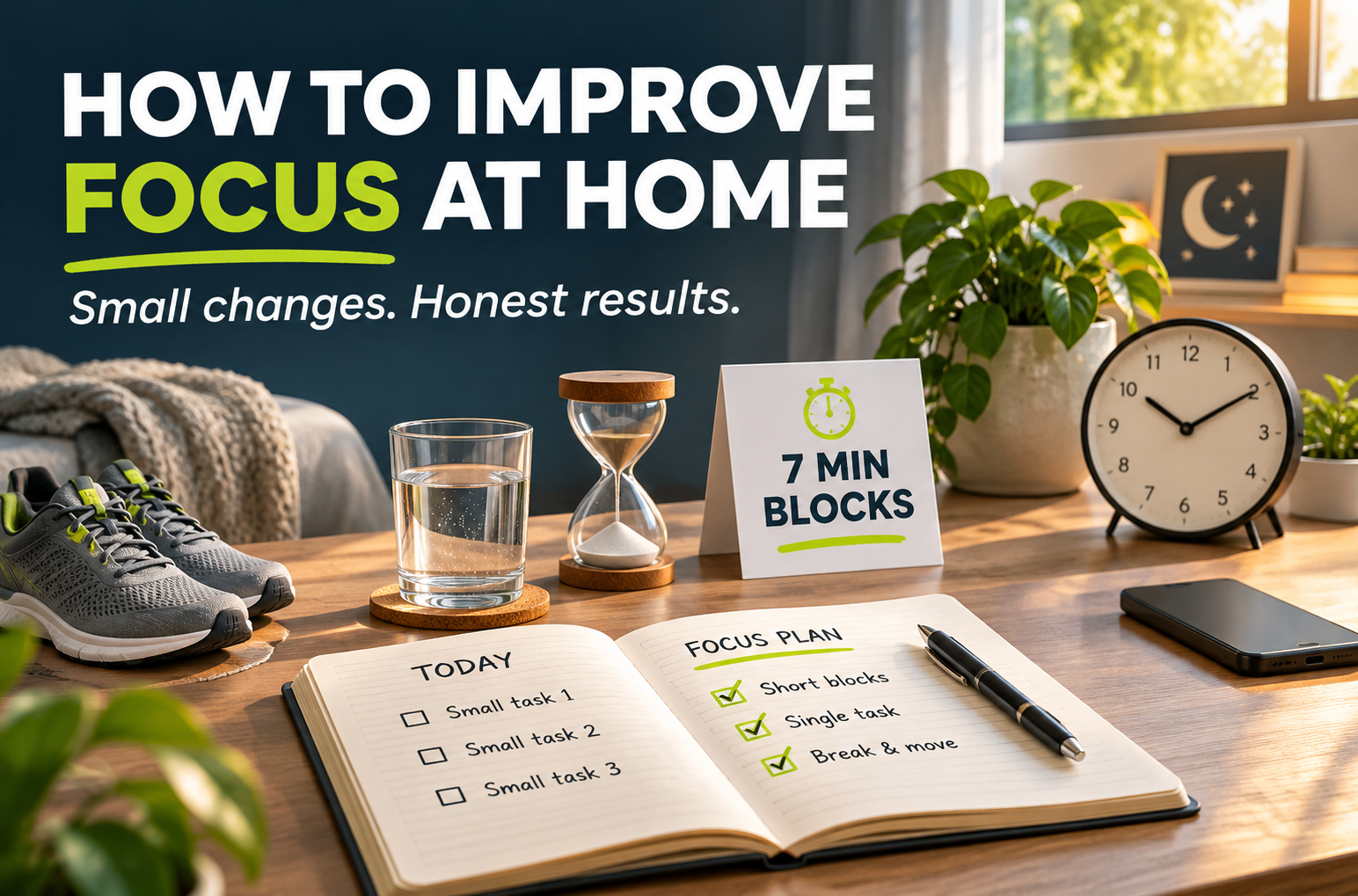
Three blocks of seven minutes is a different task from one block of twenty, even though the arithmetic is nearly identical.
Most advice on how to improve focus starts with the environment. It is the wrong starting point, because an impossible task in a perfect room is still an impossible task.
So before changing anything about your environment or your diet, change the unit. Pick a block short enough that you are confident you can finish it, do that, and stop. Then do another. The confidence that you will finish is the active ingredient, which is why shrinking the block works even when it looks like it should not.
The same principle applies to the instruction itself. One step at a time, written down rather than held in your head, with the next action phrased so specifically that no decision is required to begin it. “Sort out the insurance” is not a task. “Open the folder and find the renewal date” is.
The most-repeated focus tip on the internet
You will have read this one everywhere: put your phone in another room, because its mere presence drains your mental capacity even when it is switched off.
It comes from a well-known 2017 study in which participants whose phones were in another room outperformed those with phones on the desk, with the researchers describing a linear trend — the more noticeable the phone, the less cognitive capacity available. It is a memorable finding and it has been repeated on practically every focus article since.
A pre-registered direct replication, using the same tasks and conditions, found no difference between the phone locations at all. The effect did not replicate.
I am including this partly because it is interesting and partly because of what it says about health advice generally. A single striking result becomes a fact through repetition rather than through evidence, and nobody circles back when the follow-up work comes in quieter. We have written separately about that problem in how to know what health advice to trust.
Should you still put your phone in another room? Probably, yes — but for the plain reason rather than the exotic one. If it is on the desk you will pick it up, and once you have picked it up you have lost the thread. That is an ordinary, well-understood problem and it does not require a disputed mechanism to justify acting on it. Silencing notifications is the same argument.
Keep the advice. Drop the claim that it works even when you never touch it, because that part is not settled.
What movement actually does, with honest numbers
Exercise is the intervention most often oversold in this area, so here is what the research supports.
A single bout of activity produces a small but real improvement in attention and executive function afterwards — effect sizes generally in the range of about 0.13 to 0.43 across meta-analyses, depending on the task and population. Small, replicated, worth having, and nothing like a transformation.
Three practical details are more useful than the headline.
- The benefit arrives after, not during. Pooled results show cognitive performance slightly impaired while exercising and improved afterwards. Exercise before the work, not as an attempt to do both at once.
- Hard is not better than moderate. A meta-analysis of high-intensity exercise found it beat rest, but did not beat low-to-moderate exercise. One review found that moderate intensity improved response time while vigorous intensity actually worsened accuracy.
- Short counts. The studies here use single bouts, frequently fifteen to thirty minutes. A brisk walk qualifies.
So the practical version is genuinely modest: a walk before the thing you need to concentrate on, at an intensity you would describe as comfortable. If you want to calibrate that properly, see how hard should I be exercising.
Sleep, which is boring and wins anyway
Sustained attention is among the first things to go when sleep is short, and it goes before you notice. The characteristic experience is not feeling sleepy — it is reading the same paragraph three times and blaming the paragraph.
No technique on this page compensates for a persistent sleep debt, and nothing else here has as large an effect. It is the least interesting advice available and it remains the correct answer more often than anything else.
The practical versions are at how to sleep better naturally and, for the particular problem of a mind that will not settle at bedtime, how to relax when your mind won’t switch off.
Work with your own clock
Most people have two or three hours a day when difficult work is markedly easier, and most people spend those hours on email.
Spend a week noting roughly when your good stretch falls. Then defend it — put the hardest thing there and move the administration to the flat part of the day. This costs nothing and routinely produces more improvement than any supplement, device or technique a person could buy.
The afternoon dip is normal rather than a failure of will. Plan around it instead of fighting it.
Nobody thinks of this as part of how to improve focus, because it involves no effort and nothing to buy. It is nonetheless one of the two or three highest-yield changes on this page, and it takes a week of noticing to work out.
Why starting is the hardest part
For a lot of people the difficulty is not sustaining attention at all. It is the gap between knowing you need to begin and being able to begin, which is a distinct function and can be weak while everything else about a person is sharp.
Attention is also far more responsive to interest, novelty and urgency than to importance. This is why the same person can lose five hours to something absorbing and cannot manage five minutes on a form. It is a well-described pattern, not a contradiction in character.
What helps, practically:
- Make the first action absurdly small. Open the document. Not write the report.
- Borrow urgency where none exists naturally — a timer, a stated finish time, somebody expecting it.
- Work alongside another person, in the room or on a call, each doing your own thing. Oddly effective, and it costs nothing.
- Put the next action in writing at the end of each session, so tomorrow begins without a decision.
If that description of starting lands uncomfortably close to home, it is worth reading our clinic’s page on why ADHD is not laziness, which covers what the imaging research actually shows.
Where not to spend your effort first
A short note, in the spirit of being useful rather than exhaustive.
Brain-training games reliably make you better at those games, with limited evidence that the gains carry over to attention in daily life. Focus supplements are a large category with a wide range of quality and, for most people eating adequately, no established benefit. Caffeine genuinely works, modestly and briefly, and it is worth keeping an eye on whether yours has quietly crept up to the point where it is affecting your sleep — which costs you more focus than the caffeine returns.
None of these are disasters. They are simply further down the list than task size, sleep, your daily clock and a walk, all of which are free.
Dr. Cormier has written about this instinct — reaching for something to add when the answer is usually something to remove — in I thought my job was to give people more.
When difficulty focusing is worth a conversation
Most concentration problems are circumstantial. Some are not, and these are worth raising with a clinician rather than managing indefinitely with technique.
- Difficulty that has been lifelong and consistent across school, work and home rather than recent.
- A clear change from your own normal, over weeks or months.
- Focus problems alongside persistent low mood, loss of interest or marked anxiety.
- Heavy snoring, waking unrefreshed, or daytime sleepiness, which can point to a treatable sleep problem.
- Focus changes alongside other physical symptoms, or around the menopause transition.
Several causes here are straightforward to test for and treat. The reasons concentration goes are covered from the clinical side at why can’t I focus, and the guide to judging the moment is at when to see a doctor.
If you are supporting somebody else — a child, a partner, a colleague — the single most useful change is in how the task gets framed. “This task is badly sized, let us resize it” produces different results from “you need to concentrate harder”, and it does not lower the standard. For children specifically, see our full guide to supporting a child with ADHD at home.
The order to do these in
Everything above is worth doing, but not all at once and not in any order. If you are starting today, this is the sequence I would use.
- Shrink the block until you are certain you will finish it, and write the next action down specifically. Same-day effect, costs nothing.
- Find your good stretch over a week and defend it. Also free, and it compounds.
- Deal with the sleep, which takes a fortnight to show and outperforms everything else once it does.
- Add a walk before difficult work, at a comfortable intensity.
- Move the phone and silence the notifications — last on the list, not first, despite being the advice everybody leads with.
Four of those five are free and none of them require a product. That is the honest summary of how to improve focus for most people most of the time, and the reason this page does not end with something to buy.
If you are doing this for a child rather than yourself, the age-appropriate version is set out in full in our guide to how to support a child with ADHD at home, and much of it applies to any child who finds sitting still difficult.
Frequently asked questions
How long does it take to improve focus?
It depends which part of how to improve focus you start with. Changes to task size and environment can work the same day, because they alter the demand rather than your capacity. Sleep improvements typically show within one to two weeks. Nothing here needs months before it is worth doing.
Does exercise really help concentration?
Yes, modestly and reliably. A single bout produces small improvements in attention afterwards, with effect sizes around 0.13 to 0.43 across analyses. Moderate intensity performs about as well as hard, and the benefit comes after exercising rather than during.
Should I put my phone in another room?
Probably, but for the simple reason rather than the famous one. The widely quoted finding that a phone drains your capacity even when untouched failed to replicate in a pre-registered study. What is not in doubt is that a phone on the desk gets picked up, and picking it up loses you the thread.
Why can I focus on some things for hours and not others?
Attention responds much more strongly to interest, novelty and urgency than to importance. The unevenness is characteristic of how attention works rather than evidence of a character problem, and it is more pronounced in some people than others.
What is the single most effective thing?
Sizing the task so you are confident you can finish the block you have set. It is free, it works immediately, and it is the one almost nobody tries before buying something.
Build it into the week
The common thread in how to improve focus is that most of it is subtraction and sequencing rather than anything added. Shorter blocks, a protected hour, a walk beforehand, and enough sleep to make the rest of it work.
Our 28-Day Cell Sparking Challenge puts the daily foundations in place over four weeks with no equipment, and becoming a Body Charger member is the simplest way to follow it alongside other people. If you are not sure where to begin, start with where to start with your health.
Spark your cells to optimal longevity.
— Dr. Chris Cormier, DC
Body Chargers