By Dr. Chris Cormier, DC — Body Chargers
Most of what gets written about health comes with a quiet caveat about the evidence being thin. This is not one of those subjects.
How to improve balance is one of the best-studied questions in the whole of preventive health, with over a hundred randomised trials behind it and tens of thousands of participants. The conclusion is clear, it is encouraging, and one part of it genuinely surprises people.
Balance is a trainable skill at any age. It is not a fixed trait you are gradually losing.
Balance is a system, not a talent
Standing still looks like nothing happening. It is actually a continuous, high-speed negotiation between several systems.
Your inner ear reports head position and movement. Your eyes report where you are in the room. Sensors in your feet, ankles, knees and hips report pressure and joint angle. Your brain integrates all three streams, decides what is happening, and fires the right muscles to correct before you have consciously noticed anything at all.
What changes with age is rarely any single part of that system failing. More often it is that the whole loop runs slightly slower and with less precision, and that the muscles asked to make the correction are not as quick or as strong as they were. Both of those are responsive to training, which is the encouraging part.
That integration is a skill. Skills respond to practice. Which is why the answer to how to improve balance is not a supplement or a gadget — it is repetition of the specific thing you want to get better at.
What the evidence actually says
Anybody asking how to improve balance deserves a straight answer about what has actually been tested, so here is the body of evidence in full.
A Cochrane review brought together 108 randomised controlled trials involving 23,407 people across 25 countries. The average participant was 76 years old.
- Exercise reduced the number of falls over time by around twenty-three per cent, and the number of people having one or more falls by around fifteen per cent.
- Exercise that mainly involved balance and functional training reduced the rate of falls by twenty-four per cent — and this was high-certainty evidence from thirty-nine studies, which is about as strong as this field gets.
- Programmes combining balance and functional work with resistance exercise reduced falls by around twenty-eight per cent.
- Tai Chi reduced falls by around twenty-three per cent.
To put the first figure in human terms, the reviewers offered this: if there were 850 falls among 1,000 people over a year, exercise would mean roughly 195 fewer falls.
And one number matters more than all the others for anybody deciding what to actually do.
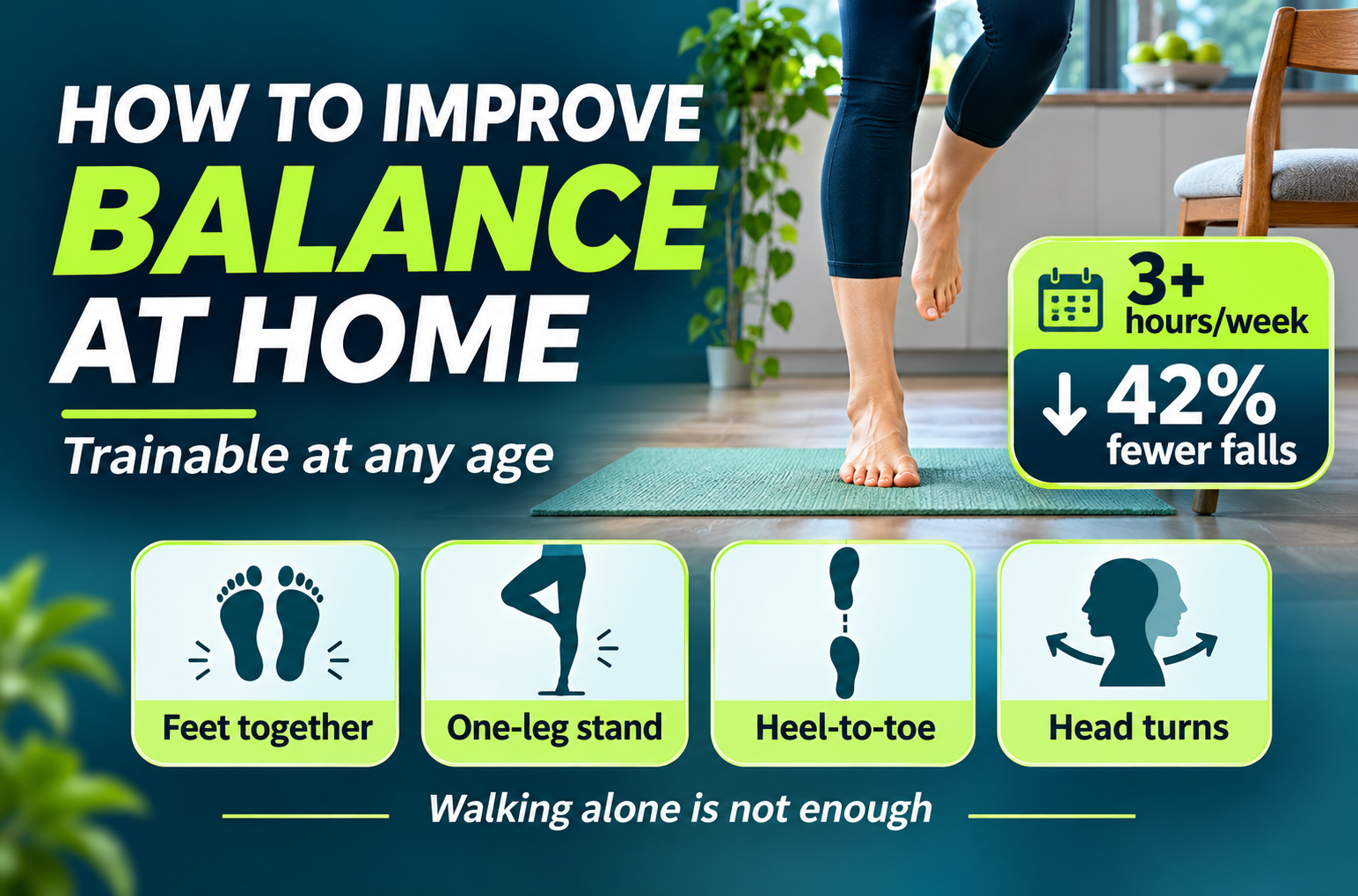
Programmes totalling three or more hours a week that included balance and functional exercises reduced the rate of falls by forty-two per cent.
That is the dose. Three hours a week, and the exercise has to challenge your balance specifically.
The part that surprises everybody
Walking, on its own, is not enough.
The same review found insufficient evidence to determine the effects of programmes that were mainly walking, mainly resistance exercise, or mainly flexibility or endurance work. The benefit is specific to exercise that challenges balance.
This genuinely catches people out, because walking is the thing most of us reach for and it is excellent for a long list of other reasons. It is simply not the same stimulus. Walking on a flat pavement in a straight line asks very little of your balance system, because nothing is threatening it.
Strength work has the same gap — valuable, and not a substitute. Our guide to how to build strength at home after 50 covers that side, and the two together are better than either alone, which is what the combined-programme figure reflects.
What “challenging your balance” means
This is the practical core of how to improve balance, and it comes down to three principles.
- Reduce your base of support. Feet together is harder than feet apart. Heel-to-toe is harder again. One foot is hardest.
- Move your centre of mass. Reaching, turning, stepping and leaning all make a position harder than holding still.
- Reduce hand support. Two hands on the counter, then one, then a fingertip, then none. This is the main way you progress.
If an exercise feels completely secure, it has stopped training anything. You want the mild wobble — that is the system working, and the working is the training.
Set up so that a wobble is never a problem. Stand beside a kitchen counter or a sturdy chair back, with something solid within arm’s reach on both sides, and nothing underfoot to trip on. Hold on at first. If you feel dizzy or lightheaded, stop and sit down. If you have already had a fall, have a neurological condition, or feel unsteady on an ordinary day, speak to a clinician before starting rather than after.
Things to practise at home
All of these are done next to a support. Progress by reducing how much you hold on, not by doing anything dramatic.
Feet together, then heel-to-toe
Stand with feet touching, hold the counter, and build to thirty seconds. Then place one heel directly in front of the other toe, as though on a line, and work up to the same. Swap which foot leads.
Standing on one leg
The classic, and a reasonable rough gauge of where you are. Lift one foot a few inches, hold the counter, and build up gradually. Then try it with one finger resting on the counter instead of a grip.
Sit to stand without using your hands
From a dining chair, arms crossed over your chest, stand and sit under control. This trains the strength and the movement pattern you use dozens of times a day, and it is one of the most transferable things on this list.
Heel-to-toe walking
Ten steps along a kitchen counter, placing each heel directly in front of the opposite toe, fingers trailing the surface.
Head turns while standing
Stand with feet together and slowly turn your head left and right, then up and down. This deliberately disrupts the visual and inner-ear inputs while you stay upright, which is exactly the integration you want to train. Keep a hand on the counter for this one.
Walking with turns
Walk a few steps, turn, walk back. Turning is when a great many real-world stumbles happen, and almost nobody practises it.
Making three hours a week realistic
Three hours sounds like a lot until you realise it does not have to look like exercise at all.
Balance work is unusual in that it stacks neatly onto things you already do standing up. A minute here and there, several times a day, adds up faster than a weekly session and is far more likely to survive a busy fortnight.
This is the single most useful thing to understand about how to improve balance in real life. The research dose is not three hours of anything that looks like a class. It is three hours of your balance being asked to work, accumulated in whatever units your week allows.
- Stand on one leg while the kettle boils, holding the counter.
- Heel-to-toe along the counter while you wait for the microwave.
- Feet together while brushing your teeth, with the basin right there.
- Stand up from your chair without using your hands, every time, as a default.
- Take the stairs deliberately rather than quickly, with a hand ready on the rail.
The point is frequency rather than intensity. Our guide to how hard should I be exercising sets the broader bar realistically.
What the first month looks like
Progress in balance training is unusually visible, which makes it one of the more satisfying things to work on. There is no fixed timetable, and the weeks below are an illustration rather than a prescription — move on when a position feels secure, and stay longer wherever you need to.
Week one: find your starting point
Hold the counter properly and work out which positions you can already do comfortably. Feet together for thirty seconds, then heel-to-toe. Note where it starts to feel like work, because that is your training zone, and it will move.
Week two: reduce the support
Same positions, but go from a full grip to one hand, and then to a few fingers resting on the surface. This is where most of the early improvement comes from, and it is far more effective than attempting something harder while still holding on tightly.
Week three: add the movement
Bring in head turns, reaching, and walking with turns. Movement is what makes the training transfer to real life, because real stumbles almost never happen while standing still.
Week four: make it routine
Stop thinking of it as a session and attach it permanently to the things that prompt it — the kettle, the toothbrush, the chair. Anybody who has reached this point has already answered how to improve balance for themselves, and the rest is simply not stopping.
One thing worth knowing while you practise: the brain is doing the integration work here, and it is an organ with a very high demand for oxygen and blood flow relative to its size. The clinic’s sister site covers that in why the brain needs oxygen, and the same daily foundations that support circulation support this.
Fear of falling
This deserves naming, because it is common, it is rarely discussed, and it works against you quietly.
Somebody has a near-miss. They become more careful. Being careful means doing less, going out less, and moving less confidently. Doing less means losing strength and balance practice. Losing those raises the actual risk, which produces another near-miss.
The way out of that loop is not to be braver. It is to practise in conditions where a wobble genuinely does not matter — beside a counter, holding on — so that confidence is rebuilt on something real rather than on being told not to worry.
Dr. Cormier wrote about how quietly the doing-less part happens, and how rarely anybody notices it in themselves, in the morning you stopped noticing.
The causes worth checking
Exercise is the biggest lever, and it is not the only one. Several contributors to unsteadiness are entirely fixable and sit outside anything you can train.
- Medications, particularly several taken together, and particularly anything sedating or affecting blood pressure. A pharmacist review is quick and free in many places.
- Vision. An out-of-date prescription, or varifocals on stairs, both matter more than people expect.
- Blood pressure dropping on standing, which produces the brief swimmy feeling when you get up.
- Feet and footwear. Pain, numbness, and backless or worn shoes all reduce the information your feet are sending.
- Inner ear problems, which are common, treatable and frequently missed.
Anybody who has actually had a fall should see a clinician for a proper falls assessment rather than treating it as bad luck. Our guide to when to see a doctor covers how to judge that, and the clinic’s page on muscle loss after 50 explains why strength underpins all of this.
If there is a neurological condition involved
Everything above is written for general use. If balance is affected by a diagnosed neurological condition, the programme should be set by a physiotherapist who works with that condition rather than taken from a website — including this one.
The principle still holds, though, and it holds strongly: exercise is recommended early and throughout, and balance work is part of it. The clinic covers that in the early signs of Parkinson’s, where exercise is the single most encouraging thing in the whole picture.
Frequently asked questions
How long does it take to improve balance?
Most people who set out to learn how to improve balance notice something within a few weeks of regular practice, and the trial evidence is built on programmes run over months. It responds to consistency rather than intensity, so little and often beats one long session.
Does walking improve balance?
Not on its own, which surprises most people. Reviews found insufficient evidence for programmes that were mainly walking. Walking is excellent for many other reasons, but balance improves from exercise that specifically challenges balance.
How much balance exercise do I need?
The strongest result came from programmes totalling three or more hours a week that included balance and functional exercises, which reduced the rate of falls by around forty-two per cent. That can be accumulated in short bursts through the day.
Is standing on one leg a good test of balance?
It is a reasonable rough gauge and a useful exercise, but it is not a diagnostic test and performance varies for many reasons. Use it to track your own progress over time rather than to compare yourself against anybody else.
Is it safe to do balance exercises alone at home?
For most people, yes, provided you work beside a solid support, hold on at first and progress gradually. If you have had a fall, feel unsteady on ordinary days, get dizzy, or have a diagnosed neurological condition, speak with a clinician before starting.
Build it into the rest
Balance work sits alongside the other daily foundations rather than replacing any of them, and the version that lasts is the one that attaches to things you already do. Knowing how to improve balance is the easy part, and doing a little of it most days is the whole of the rest.
Our 28-Day Cell Sparking Challenge sequences those foundations over four weeks with no equipment, and becoming a Body Charger member is the simplest way to follow it alongside other people. If you would rather ease in, start with where to start with your health.
Spark your cells to optimal longevity.
— Dr. Chris Cormier, DC
Body Chargers